
Almost every peptide sold for research use is advertised with a purity figure, and almost none of the people reading that figure have been shown what it measures. “99% pure” is doing a lot of work in a sentence where nobody has said pure of what, measured how, or in which vial.
This guide walks through a real certificate of analysis line by line. It is one of ours — job #26998, BPC-157, tested in August 2025 — and you can pull the original from the testing laboratory’s own site while you read. Everything here transfers to any COA you are handed, including from vendors other than us.
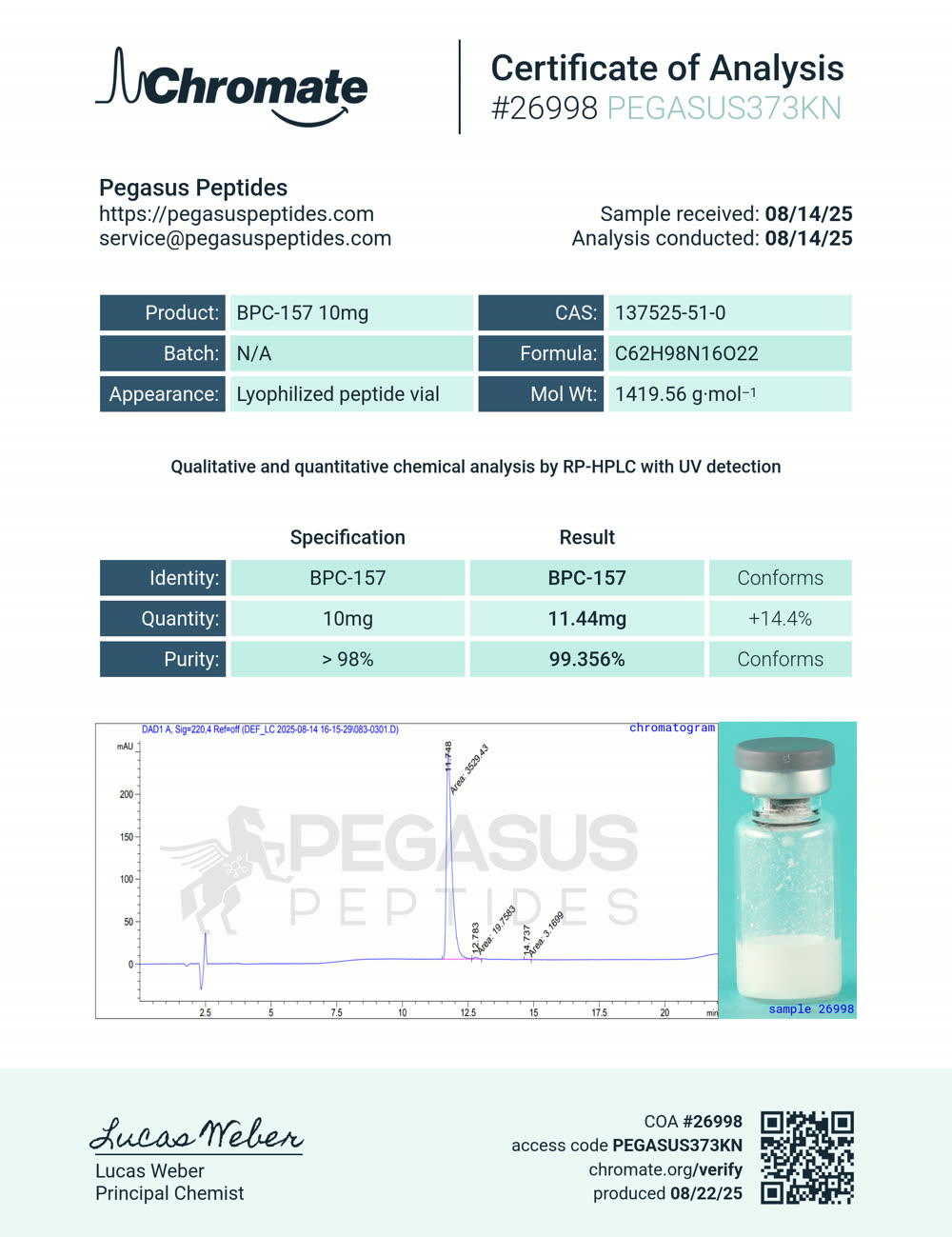
Open it at chromate.org/verify
— access code PEGASUS373KN — and follow along on the original.
What a COA is, and what it is not
A certificate of analysis is a laboratory’s written record of the tests it ran on a sample it was sent, and the results it got. That is the whole of it. Three things follow from that definition, and all three are routinely misread:
- It describes a sample, not a product line. The laboratory tested what arrived in the envelope. Whether the vial in your hand came from the same material is a question about the seller’s record-keeping, not about the certificate.
- It is not a safety or suitability assessment. Nothing on a COA speaks to whether a compound is safe, effective, or appropriate for any use. A COA for a highly toxic substance looks exactly like a COA for an inert one.
- It is not a regulatory approval. A laboratory issuing a COA is reporting measurements. It is not certifying that anything may lawfully be sold, imported, or administered.
What a COA can tell you is whether the material tested was the molecule it was supposed to be, roughly how much of it there was, and how much of the material that the detector could see was something else. That is genuinely useful. It is also narrower than most people assume.
1. Start at the bottom: does the document exist?
Work backwards. Before reading a single result, establish that the certificate is real, because a PDF is a picture and pictures can be edited by anyone with ten minutes and a free image editor. Purity figures are the easiest thing in the world to retype.
At the foot of this certificate there are three things that matter:
- A job number — #26998
- An access code — PEGASUS373KN
- The address of the laboratory that issued it — chromate.org/verify
Those exist so you can ignore the document entirely and go and ask the laboratory directly. Type the job number and access code into the laboratory’s own site and it returns its copy of the record. If the two disagree, the copy you were handed is the one that is wrong. The QR code beside them encodes the same link for anyone reading a printed copy.
This is the single most useful habit in this guide, and it is the one that costs the least effort. A vendor who publishes a purity figure with no independent record behind it is asking to be taken at their word, and every other number on the page rests on that. If there is no verification route, stop reading — nothing below can be checked.
2. The header: who tested what, and when
The top block names the laboratory, the client who submitted the sample, and the dates. On this certificate the sample was received on 14 August 2025 and analysed the same day, with the finished document produced on 22 August.
Dates are worth a glance for two reasons. A long gap between receipt and analysis raises the question of how the sample was stored in between. And a certificate dated years before the material was offered for sale is describing a different batch of manufacturing than the one being sold, whatever the seller says.
The batch field
Directly under the product name is a field marked Batch, and on this certificate it reads N/A.
A batch number — or lot number — is an identifier a manufacturer assigns to one production run: one synthesis, one purification, one filling session. Its purpose is to make a certificate transferable to a specific vial. When a COA carries a lot number and the vial carries the same lot number, the chain is complete: this document describes the material in this container. When the field is blank, the certificate still records a real analysis of a real sample, but the link between the tested sample and any particular vial rests on the seller’s internal records rather than on anything printed.
This is worth understanding rather than worrying about, and it is the field most people skip. It also explains why two certificates for the same compound can differ: they may describe genuinely different production runs.
3. The identity block: is it the right molecule?
Beside the product name sit three pieces of chemical identity, and they exist so that you can check the certificate against an independent source:
- CAS number: 137525-51-0
- Molecular formula: C62H98N16O22
- Molecular weight: 1419.56 g·mol−1
A CAS number is a unique registry identifier for a substance. A formula and a molecular weight are properties of the molecule that follow from its structure. All three can be looked up in a public database such as PubChem in under a minute, and all three should agree with each other — the formula should compute to the stated weight, and both should match what the CAS number refers to. For BPC-157, a fifteen-residue peptide, they do.
When they do not agree, something is wrong that has nothing to do with the sample: either the certificate was filled in carelessly, or it was filled in for a different compound. It is a cheap check and it occasionally catches something.
The limit worth knowing. This certificate establishes identity by RP-HPLC with UV detection. That method separates a mixture by how strongly each component sticks to a column, and reports when each one comes off. A sample whose main component comes off at the expected time, and whose behaviour matches a reference standard, is consistent with being the stated compound — but retention time is a property of how a molecule behaves on a column, not a direct reading of its structure. Two different molecules of similar size and water-repellency can elute at similar times.
The technique that reads structure directly is mass spectrometry, which weighs the molecule, and tandem MS, which can read the amino acid sequence. Neither was run here. “Identity: Conforms” on an HPLC-only certificate means consistent with, which is a real and useful finding, and it is not the same as confirmed to be.
4. The results table
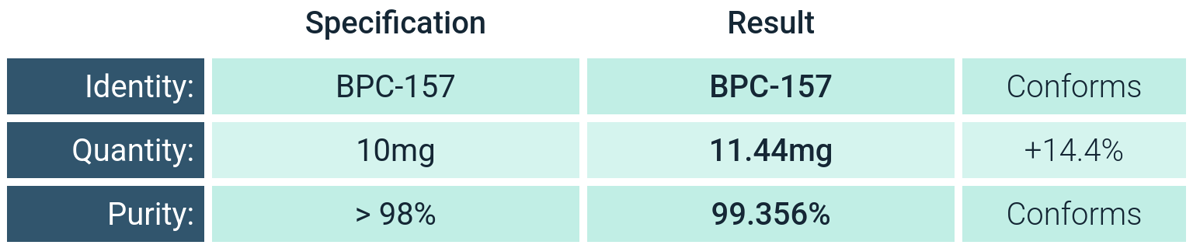
The table has a specification column — what the material was supposed to be — and a result column — what the laboratory measured. The third column reports the verdict, and it behaves in a way that is not explained anywhere on the certificate but is consistent across every one we have had issued:
- Where the result falls inside tolerance, the column reads Conforms.
- Where it falls outside, the column reports the signed deviation instead — how far out, and in which direction.
So a cell containing a number rather than the word “Conforms” is the certificate telling you something specific. Here, Quantity reads +14.4%: the vial was specified at 10 mg and measured at 11.44 mg. Comparing across our certificates, the quantity tolerance appears to sit at about ±10% — deviations inside that band are marked as conforming, and deviations outside it get a number.
A positive deviation is an overfill. In practice that means more material than the label claims, which matters less to a buyer than the reverse but matters a great deal to anyone calculating a concentration from the label rather than from the certificate. A negative deviation is an underfill, and it is worth checking for on any certificate you are shown.
Purity reads 99.356% against a specification of greater than 98%, and conforms. What that figure actually measures is the next section, and it is the part most often misunderstood.
5. Reading the chromatogram
The chromatogram is the evidence behind the purity number, and it is the part of a COA most people skip. It is also the part that is hardest to fake convincingly, which makes it the most informative thing on the page.
The header line
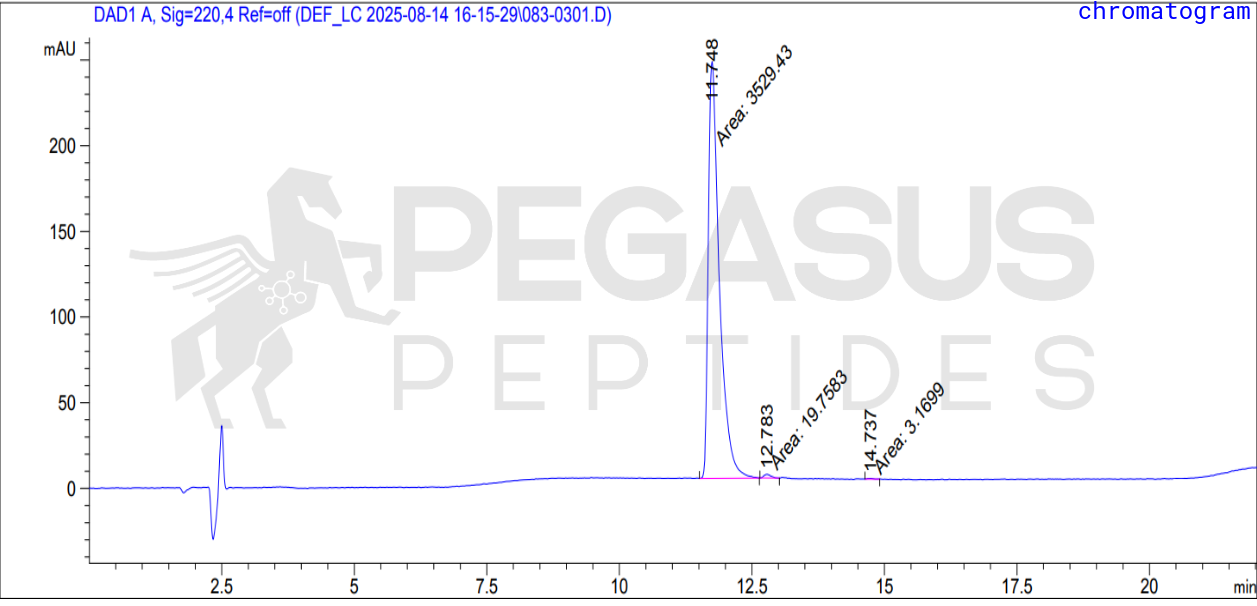
Across the top: DAD1 A, Sig=220,4 Ref=off. A diode-array detector, reading at 220 nm with a 4 nm bandwidth, with no reference wavelength subtracted.
The wavelength is not arbitrary. The peptide bond — the amide linkage joining one amino acid to the next — absorbs ultraviolet light strongly in the region around 205–230 nm, and 214 nm and 220 nm are both conventional choices within it. Reading there detects essentially any peptide in the sample, in rough proportion to how many bonds it has.
The alternative, 280 nm, sees only the aromatic residues tryptophan and tyrosine. That is a more selective measurement with a quieter baseline, but it is useless for a peptide containing neither — and BPC-157, whose fifteen residues include no aromatics at all, is exactly such a peptide. It would be close to invisible at 280 nm. So the thing to check is not the specific number but the region: a peptide purity figure determined at 280 nm, for a peptide with no strong chromophore, is measuring very little.
The two axes
Horizontally: retention time in minutes, how long each component took to travel through the column. Vertically: absorbance in milli-absorbance units (mAU), how much light the detector saw absorbed at that moment. A peak is a component leaving the column.
The spike at 2.5 minutes is not an impurity
The first thing on the trace is a sharp spike just before 2.5 minutes that goes up to about 37 mAU and then down below the baseline to about −30. It is large, it is early, and it is not a contaminant.
This is the solvent front — the moment the injection solvent and anything not retained by the column at all wash through together. Every reversed-phase chromatogram has one. It marks the earliest time anything can possibly appear, and material eluting there has by definition not interacted with the column, so it cannot be separated or identified. It is excluded from the purity calculation for that reason. Reading it as a giant impurity peak is the single most common misreading of a chromatogram.
The peaks that count
Three peaks are labelled with a retention time and an integrated area:
- 11.748 min — area 3529.43. The main peak. This is the BPC-157.
- 12.783 min — area 19.7583. A small late-eluting component.
- 14.737 min — area 3.1699. Smaller still.
The two minor peaks are related substances: things structurally close to the target and produced alongside it. In peptide synthesis the usual candidates are sequences missing a residue, sequences carrying a leftover protecting group, and molecules that have oxidised or deamidated in storage. That they elute after the main peak means they stick to the column more strongly than the target does — typically a sign of something slightly more water-repellent, which fits a modified or incompletely deprotected peptide.
The faint pink line drawn under the peaks between roughly 11.5 and 15 minutes is the integration baseline — the software’s decision about where each peak starts and stops, and where zero sits beneath it. Peak areas are measured relative to that line, which is why two analysts can get slightly different numbers from the same raw data.
What a good chromatogram looks like
- A flat baseline. Between the solvent front and the main peak this trace sits close to zero and stays there. Drifting, wandering or noisy baselines make small peaks unmeasurable.
- One dominant peak. Tall, narrow, and symmetric. A peak that leans hard to one side or has a shoulder on it may be two components the column failed to separate.
- A run long enough to be honest. This one continues to about 22 minutes, well past the last peak of interest. A chromatogram that stops immediately after the main peak cannot show you what would have come off later.
- Labelled minor peaks. Impurities that are named and integrated are impurities the laboratory is accounting for.
6. Check the arithmetic yourself
Purity on a chromatogram like this is calculated by area normalisation: the area of the target peak divided by the total area of every integrated peak, expressed as a percentage. That is a sum you can do from the printed numbers, and doing it is the fastest way to find out whether a certificate’s headline figure has any relationship to its own evidence.
Worked example — COA #26998
Total integrated area: 3529.43 + 19.7583 + 3.1699 = 3552.3582
Main peak as a fraction: 3529.43 ÷ 3552.3582 = 0.993546
As a percentage: 99.355%. The certificate states 99.356%.
Those agree to within about a thousandth of a percentage point. A gap that size is normal and comes from where the integration baseline was drawn and how the displayed areas were rounded — not from anything being wrong. What you are checking for is not an exact match. You are checking that the headline number is the same order of thing as the evidence beneath it.
A stated purity that cannot be reconstructed from the peaks on the same page — 99% claimed over a chromatogram whose minor peaks clearly account for several percent of the area — is a serious problem, and it is visible to anyone willing to do one division.
7. Purity is not the same as content
This is the most consequential misunderstanding about peptide certificates, and it is worth being precise about.
The 99.356% figure means: of the ultraviolet-absorbing material that travelled through the column and was integrated, 99.356% of it was BPC-157. It is a statement about the composition of the chromatogram.
It is not a statement about the composition of the powder in the vial. A freeze-dried peptide is not pure peptide by weight, and never is. What else is in there:
- Water. Lyophilised material is hygroscopic and retains bound moisture; several percent by mass is typical.
- Counterions. Peptides are usually purified as a salt — commonly trifluoroacetate, sometimes acetate — and the counterion is part of the weight. For a peptide with several basic residues this alone can be a substantial fraction.
- Residual solvents and other process leftovers, in small amounts.
The result is that net peptide content — the proportion of the vial’s mass that is actually peptide — is commonly in the region of 70–85% for a material whose chromatographic purity is above 98%. Both numbers are true simultaneously. They measure different things.
Chromatographic purity is measured by HPLC. Peptide content is measured by different methods entirely — amino acid analysis, in which the peptide is hydrolysed into its constituent amino acids and each is quantified, or nitrogen determination. Neither appears on a COA of this kind, and a certificate reporting only HPLC purity is silent on content by construction.
This matters most to anyone working back from a label to a concentration. The certificate’s quantity figure — 11.44 mg here — is the more useful number for that purpose than the vial’s printed 10 mg, and neither is the same as the mass of peptide.
8. What this certificate does not tell you
Worth stating plainly, because the absence of a test is easy to overlook when the tests that were run all passed:
- Molecular confirmation. No mass spectrometry, so identity rests on chromatographic behaviour against a standard.
- Water content. No Karl Fischer titration or loss-on-drying figure, so the moisture fraction is unquantified.
- Peptide content. No amino acid analysis, for the reasons above.
- Residual solvents. Not assayed.
- Endotoxin, sterility and bioburden. Not assayed, and not implied by anything on the page.
- Stability. A COA is a snapshot of one day. It says nothing about how the material behaves after months on a shelf.
None of this makes the certificate less genuine. It makes it a certificate of the tests it reports, which is all any COA ever is.
A checklist
Everything above, compressed to what you would actually do with a certificate in front of you:
| Check | What you are looking for |
|---|---|
| Is there a verification route? | A job number, an access code and the laboratory’s own address. Use them. Without this, nothing else is checkable. |
| Is the laboratory named? | An identifiable third party, not the seller’s own quality department and not an unnamed “partner lab”. |
| Do the identifiers agree? | CAS number, molecular formula and molecular weight should be mutually consistent and match a public database. |
| Is there a chromatogram? | A summary table with no trace behind it is an assertion. The chromatogram is the evidence. |
| Does the purity figure reconstruct? | Divide the main peak area by the total. It should land within a rounding error of the stated figure. |
| Does the run continue past the main peak? | A trace that ends moments after the target cannot show later-eluting impurities. |
| What does the third column say? | A number instead of “Conforms” is a flagged deviation. Read which direction it goes. |
| What was not tested? | Mass spectrometry, water content, peptide content, endotoxin. Absence is not failure, but it is not a pass either. |
Our certificates
Every batch we sell is submitted to an independent laboratory, and the resulting certificate is linked from the product page it belongs to, with the job number and access code intact so you can pull the laboratory’s own copy rather than ours. The one used throughout this guide is COA #26998, for BPC-157.
If a term here was unfamiliar, the peptide glossary defines the vocabulary used across these articles — lyophilised, HPLC, half-life and the rest — in plain language.
Standards and further reading
The conventions described above are not house style; they come from the analytical literature and from pharmacopoeial method standards. For readers who want the primary material:
- United States Pharmacopeia, General Chapter <621> Chromatography. The reference standard for chromatographic method definitions, system suitability and peak integration.
- ICH Q2(R2), Validation of Analytical Procedures (2023). The international guideline governing what it means for an analytical method to be validated for specificity, accuracy and precision.
- ICH Q3C(R8), Impurities: Guideline for Residual Solvents. Sets the classification and limits for solvent residues that an HPLC purity assay does not measure.
For laboratory research use only. Not for human consumption. The materials referenced on this page are not drugs, foods, or cosmetics and may not be sold or used for any purpose other than in vitro or non-human laboratory research.