
Overview
5-Amino-1MQ — full name 5-amino-1-methylquinolinium — is a small-molecule inhibitor of nicotinamide N-methyltransferase (NNMT), studied in research on adipose tissue metabolism, energy expenditure and NAD+ availability. It is the most-studied member of a family of methylquinolinium NNMT inhibitors developed as chemical tools for investigating what happens when that enzyme is switched off.
It is also the odd one out in this catalogue. Almost everything else here is a peptide; 5-Amino-1MQ is a single aromatic heterocycle roughly one four-hundredth the mass of the larger peptides on these pages. That difference is not incidental — it changes how the compound behaves, how it is stored, and how its identity should be verified.
Chemical identity
5-Amino-1MQ is a quinolinium cation: a bicyclic aromatic system with a permanently methylated, positively charged ring nitrogen and an amino group at the 5-position.
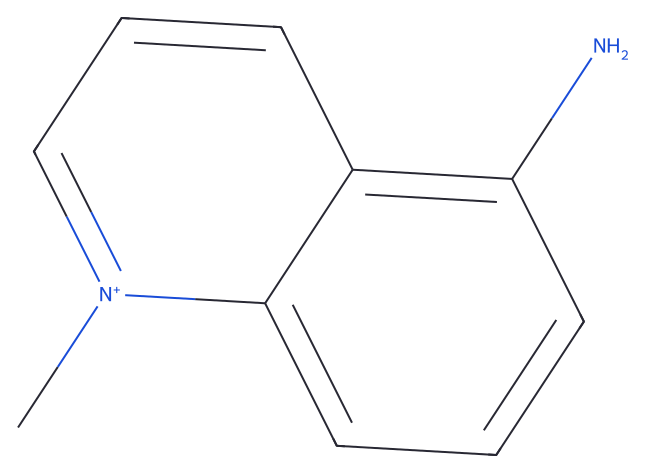
cation with a 5-amino substituent.
PubChem CID 950107
- CAS number: 42464-96-0
- Molecular formula: C10H11N2+
- Molecular weight: 159.21 g/mol
- Classification: Small-molecule NNMT inhibitor, quinolinium salt
- Appearance: Crystalline solid
- Solubility: Water-soluble; the permanent cationic charge makes it markedly more polar than a neutral small molecule of similar size
The permanent positive charge is the design feature. It mimics the methylated nicotinamide product that NNMT releases, which is what allows the molecule to occupy the enzyme’s active site. Because the charge is fixed rather than pH-dependent, the compound stays ionised across physiological conditions — good for aqueous solubility, and a constraint on membrane permeability that this compound series was specifically engineered to overcome.
What NNMT does
Nicotinamide N-methyltransferase transfers a methyl group from S-adenosylmethionine (SAM) onto nicotinamide, producing 1-methylnicotinamide and S-adenosylhomocysteine. It is a cytosolic enzyme, expressed most heavily in liver and in adipose tissue, and its expression rises in adipose tissue under conditions of metabolic stress — the observation that first drew research attention to it.
The reaction consumes two things that matter elsewhere in the cell. It consumes nicotinamide, which would otherwise be recycled into NAD+ through the salvage pathway. And it consumes a methyl group from SAM, the cell’s principal methyl donor for reactions ranging from DNA and histone methylation to catecholamine synthesis. NNMT therefore sits at a junction between NAD+ availability and methyl-group economy, which is why interest in inhibiting it extends well beyond adipose biology.
Mechanism of action
5-Amino-1MQ is described in the literature as a cell-permeable, competitive NNMT inhibitor. The research proposition is straightforward: block the enzyme, and nicotinamide that would have been methylated and excreted is instead available for NAD+ salvage, while methyl groups that would have been consumed remain in the SAM pool.
In adipocyte studies this has been associated with increased cellular NAD+, altered expression of genes involved in energy expenditure, and reduced lipid accumulation. Because the mechanism operates by conserving substrates the cell already makes rather than supplying anything exogenous, it is mechanistically distinct from direct NAD+ supplementation, and the two are sometimes examined together for that reason.
Areas of research investigation
Adipose tissue and energy metabolism
The largest body of work concerns adipocytes. Knockdown and inhibition studies in mouse models have reported reduced fat mass and changes in adipose gene expression under high-fat-diet conditions, and this line of research is what established NNMT as a metabolic target.
Muscle and regenerative capacity
A separate line of work has examined NNMT inhibition in skeletal muscle, reporting effects on muscle stem cell activity and regenerative capacity in aged animals.
Methyl-group and NAD+ metabolism
Because the enzyme sits at the intersection of two metabolic pools, NNMT inhibition is also used as a tool compound for probing SAM and NAD+ dynamics independently of any metabolic endpoint.
What the evidence covers
The research record here is preclinical. Published work is predominantly cell culture and rodent, and the compound is best understood as a chemical tool for interrogating NNMT rather than a therapeutic candidate with a clinical dossier. Two points are worth holding in mind when reading the literature:
- Inhibitor selectivity. Methyltransferases are a large family with a shared cofactor, and selectivity against related enzymes is a recurring question for any SAM-competitive or product-mimetic inhibitor. Reported potency figures should be read alongside whatever selectivity panel accompanied them.
- Permeability. A permanently charged molecule crossing membranes efficiently is not the default expectation, and the extent of cellular uptake is an active part of what published studies characterise rather than something to assume.
Handling and storage
This is where being a small molecule rather than a peptide matters most. Peptide handling is dominated by the risk of denaturation — do not shake, do not foam, avoid freeze–thaw cycles. Almost none of that applies here.
- Solid storage: keep sealed, dry and protected from light. Quinolinium salts are hygroscopic; moisture uptake is a more realistic concern than thermal degradation.
- Dissolution: readily water-soluble. There is no foaming or denaturation risk, so vigorous mixing is fine — the caution that applies to every peptide in this catalogue does not apply to this compound.
- In solution: considerably more robust than a peptide solution, and tolerant of freeze–thaw. Protect from prolonged light exposure; aromatic amines can be photosensitive.
- Concentration: our reconstitution calculator handles the arithmetic, though note the vial quantities here are small relative to the peptides — check the units carefully.
Purity and analytical verification
Identity verification differs from the peptide case in a way worth understanding, because it changes what a certificate of analysis should contain.
For a peptide, mass spectrometry is the primary identity check: the measured mass distinguishes the correct sequence from a deletion variant. For a small molecule, mass alone is much weaker evidence — many structures share a formula, and a positional isomer of 5-Amino-1MQ with the amino group at a different ring position would be indistinguishable by mass while being a different compound with different activity.
NMR is the definitive identity test here, because it resolves substitution pattern rather than just mass. A certificate offering only HPLC purity and a mass figure demonstrates that the material is pure and has the right molecular weight — not that it is the right isomer. For this compound specifically, that distinction is the one worth asking about.
We publish third-party certificates of analysis by batch.
References
- Kraus D, Yang Q, Kong D, et al. Nicotinamide N-methyltransferase knockdown protects against diet-induced obesity. Nature, 2014. PMID 24717514
- Neelakantan H, Vance V, Wetzel MD, et al. Selective and membrane-permeable small molecule inhibitors of nicotinamide N-methyltransferase reverse high fat diet-induced obesity in mice. Biochemical Pharmacology, 2018. PMID 29155147
- Neelakantan H, et al. Small molecule nicotinamide N-methyltransferase inhibitor activates senescent muscle stem cells and improves regenerative capacity of aged skeletal muscle. Biochemical Pharmacology, 2019. PMID 30753815
Summary
5-Amino-1MQ (5-amino-1-methylquinolinium) is a small-molecule NNMT inhibitor, CAS 42464-96-0, molecular formula C10H11N2+, molecular weight 159.21 g/mol. It inhibits the enzyme that methylates nicotinamide, a reaction that consumes both nicotinamide destined for NAD+ salvage and methyl groups from the SAM pool. Published research is preclinical and concentrated in adipose tissue and skeletal muscle models. As a charged aromatic small molecule rather than a peptide, it is more robust in storage and handling than most of this catalogue, and its identity is properly confirmed by NMR rather than mass alone.
For laboratory research use only. Not for human consumption. This material is not a drug, food, or cosmetic and may not be sold or used for any purpose other than in vitro or non-human laboratory research.