
Overview
AHK-Cu is a complex of the tripeptide alanyl-L-histidyl-L-lysine with copper(II). It is closely related to GHK-Cu, differing at one position, and is studied principally in the context of hair follicle biology.
It is the less-examined of the two copper peptides in this catalogue, and this page is correspondingly shorter than most. That is deliberate: there is less established about this compound, and padding the difference would misrepresent the state of the evidence.
Chemical identity
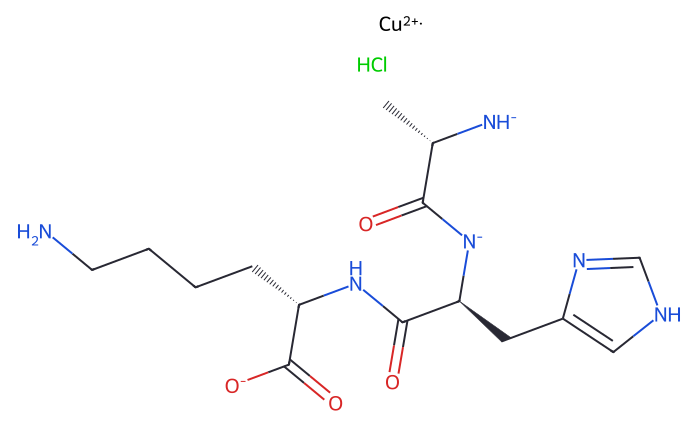
copper centre, and a chloride counterion.
PubChem CID 168431292
- Peptide sequence: Ala-His-Lys
- CAS number: 682809-81-0
- Molecular formula: C15H24ClCuN6O4
- Molecular weight: 451.39 g/mol
- Classification: Copper tripeptide complex
- Appearance: Blue to blue-violet powder — the colour is the copper
One residue from GHK-Cu
The peptides differ at position 1 only:
- GHK — Gly-His-Lys
- AHK — Ala-His-Lys
Glycine and alanine differ by a single methyl group, the smallest possible change between two amino acids. Both retain the histidine that does the copper binding — its imidazole ring is the principal coordinating group in each — and the lysine that keeps the complex soluble.
Whether that methyl group produces a meaningful difference in activity is a fair question, and the honest answer is that it has not been examined nearly as thoroughly as the existence of two separate products might suggest.
The complex types are different
This is the more consequential distinction, and it is easy to miss.
The formulae describe two different kinds of complex. AHK-Cu, at 451.39 g/mol, is a one-to-one complex — one peptide, one copper — supplied with a chloride counterion. GHK-Cu, at 744.30 g/mol, is a two-to-one complex: two peptides sharing a single copper centre, with no counterion in the formula.
The practical consequence is that molecular weights cannot be compared naively, and neither can copper content per unit mass. A given mass of AHK-Cu carries proportionally more copper than the same mass of GHK-Cu, because there is one peptide per metal rather than two. For any experiment where copper delivery is the variable, that difference matters more than the amino acid substitution does.
Mechanism
The copper-carrier principle is the same as for GHK-Cu and is described in detail there: the peptide binds copper with high affinity, holding it in a soluble, non-damaging form that free copper salts cannot provide, and copper is a required cofactor for lysyl oxidase, superoxide dismutase and cytochrome c oxidase.
What is specific to AHK-Cu is less well characterised. Research interest has centred on hair follicle biology, with reported effects on follicle growth in culture, and the mechanistic account offered is generally the same copper-dependent one rather than something distinct to this peptide.
The evidence is thin
Stated plainly, because the contrast with its relative is stark. GHK-Cu has five decades of published work behind it, including independent studies and a foundation in uncontroversial copper biochemistry. AHK-Cu does not.
Published research is limited, much of the available material originates in cosmetic-industry contexts rather than independent academic work, and there is little that examines AHK-Cu against GHK-Cu directly — which is precisely the comparison that would establish whether the substitution matters.
This does not make the compound uninteresting. It does mean that claims about it are more often extrapolated from GHK-Cu than demonstrated for AHK-Cu, and that a researcher choosing between them should know they are choosing between a well-studied compound and a much less studied analogue of it.
Handling, reconstitution and storage
The considerations are those of a copper complex rather than a peptide:
- Avoid chelating agents. EDTA and similar will strip copper from the complex, leaving free peptide and a copper chelate.
- pH matters. Copper coordination is pH-dependent; strongly acidic conditions dissociate the complex. Use neutral or near-neutral diluents.
- The colour is diagnostic. An intact copper complex is blue to blue-violet. White or off-white material is not a copper complex whatever the label says.
- Lyophilised storage: sealed, refrigerated, protected from light.
- Reconstitution: add diluent slowly down the vial wall and allow to dissolve undisturbed.
- Concentration: our peptide reconstitution calculator converts vial quantity, diluent volume and syringe size into concentration per unit.
Purity and analytical verification
The same requirement applies as for any copper peptide, and it is worth repeating because it is routinely overlooked: peptide testing cannot see the copper. HPLC separates organic molecules and mass spectrometry weighs them; neither reports whether the metal is present, absent, or in the wrong ratio. A certificate showing 99% peptide purity is silent on the thing that makes this compound what it is.
Verification requires elemental analysis — ICP-MS or atomic absorption — measuring copper content directly, and a stated stoichiometry so that measurement can be checked against an expectation.
For this compound specifically, the stoichiometry question has extra weight. Because AHK-Cu and GHK-Cu are supplied as different complex types, a supplier who has not been precise about which complex they are shipping has left the most important number undefined.
We publish third-party certificates of analysis by batch.
References
Confidence in this compound’s citation record is lower than for most pages in this library, which reflects the state of the literature rather than a gap in the search.
- Pyo HK, Yoo HG, Won CH, et al. The effect of tripeptide-copper complex on human hair growth in vitro. Archives of Pharmacal Research, 2007. PMID 17703734
- Pickart L, Margolina A. Regenerative and protective actions of the GHK-Cu peptide in the light of the new gene data. International Journal of Molecular Sciences, 2018. (GHK-Cu context rather than AHK-Cu specifically.) PMID 29986520
Summary
AHK-Cu is a complex of the tripeptide alanyl-L-histidyl-L-lysine with copper(II), CAS 682809-81-0, molecular formula C15H24ClCuN6O4, molecular weight 451.39 g/mol — a one-to-one peptide-to-copper complex with a chloride counterion, in contrast to GHK-Cu’s two-to-one form. It differs from GHK by a single methyl group and functions on the same copper-carrier principle. Research interest concerns hair follicle biology, but the published literature is substantially thinner than for GHK-Cu, and much of what is claimed for AHK-Cu is extrapolated from its better-studied relative rather than demonstrated for it directly.
For laboratory research use only. Not for human consumption. This material is not a drug, food, or cosmetic and may not be sold or used for any purpose other than in vitro or non-human laboratory research.