
Overview
KPV is the tripeptide lysine-proline-valine, corresponding to the final three residues of alpha-melanocyte-stimulating hormone. It is studied for anti-inflammatory activity, principally in models of intestinal and cutaneous inflammation.
At three residues and 342 g/mol it is the smallest peptide in this catalogue, and it is a good illustration of how little of a hormone can be needed to retain one of its activities.
Chemical identity
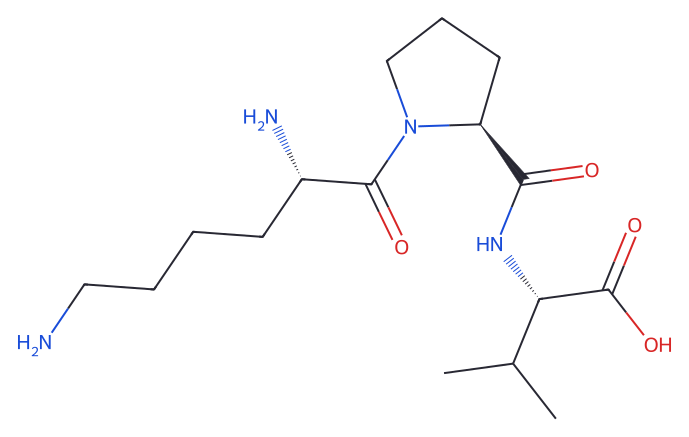
tripeptide of alpha-MSH.
PubChem CID 125672
- Sequence: Lys-Pro-Val
- CAS number: 67727-97-3
- Molecular formula: C16H30N4O4
- Molecular weight: 342.43 g/mol
- Classification: Alpha-MSH C-terminal fragment, residues 11–13
- Appearance: White lyophilised powder
The other end of the same hormone
Alpha-MSH is thirteen residues long, and two of its fragments appear in this catalogue as separate compounds. Setting them against the parent sequence makes the relationship clear:
- Alpha-MSH: Ser-Tyr-Ser-Met-Glu-His-Phe-Arg-Trp-Gly-Lys-Pro-Val
- Positions 6–9 — His-Phe-Arg-Trp — are the melanocortin receptor pharmacophore, the part that drives pigmentation, appetite and sexual function. Melanotan II is built around this core.
- Positions 11–13 — Lys-Pro-Val — are KPV, and carry anti-inflammatory activity.
This is a genuinely useful thing to understand. A single hormone’s activities are not inseparable: they map to different regions, and isolating a region isolates an activity. KPV retains anti-inflammatory effects with little or no reported activity on pigmentation, which is precisely what makes it useful as a research tool — the same reason the hGH fragment exists.
Read alongside Melanotan II, the two compounds make the point better than either does alone: one fragment of alpha-MSH darkens skin and affects appetite, another calms inflammation, and neither does the other’s job.
Mechanism of action
The reported mechanism centres on NF-κB, the transcription factor that acts as a master switch for inflammatory gene expression. Published work describes KPV interfering with NF-κB activation and reducing production of pro-inflammatory cytokines downstream.
A notable feature is that this appears to happen inside the cell rather than at a surface receptor. Unlike the melanocortin core, which works by binding receptors on the cell membrane, KPV has been reported to enter cells and act intracellularly — which is unusual for a peptide and possible here largely because the molecule is so small.
How it gets in
One line of research concerns the route of entry, and it is more interesting than it sounds.
PepT1 is a transporter expressed in intestinal epithelium whose normal job is absorbing di- and tripeptides from digested food. It is not selective about which tripeptides, and published work has reported that KPV is taken up through it — a peptide small enough to be mistaken for a nutrient.
That matters for two reasons. It offers a mechanism by which a peptide could reach intestinal epithelial cells intact, which is otherwise difficult. And PepT1 expression increases in inflamed intestinal tissue, which would concentrate uptake where inflammation is greatest. Whether that fully accounts for the colitis findings is not settled, but it is a coherent account of how a tripeptide reaches its site of action.
Areas of research investigation
Intestinal inflammation
The largest body of work, using murine colitis models. This is where the PepT1 transport findings originate and where the anti-inflammatory effects are best characterised.
Skin and wound inflammation
Studies examining inflammatory responses in dermal models, which is also the context in which KPV appears in combination products.
Melanocortin pharmacology
Separately from any application, KPV is used as a tool for dissecting which alpha-MSH activities depend on melanocortin receptor binding and which do not.
Related compounds in this catalogue
KPV appears in one of the blended products alongside GHK-Cu, TB-500 and BPC-157 — a combination assembled around tissue repair, where KPV contributes the anti-inflammatory element rather than a reparative one.
Handling, reconstitution and storage
KPV is among the most robust compounds here, and its size is the reason.
- No fragile residues. No methionine, no cysteine, no tryptophan — nothing oxidation-prone and nothing photosensitive. Proline in the middle makes the short backbone conformationally rigid.
- Lyophilised storage: sealed and refrigerated is sufficient; freeze for long-term storage.
- Readily water-soluble thanks to the lysine.
- Reconstitution: add diluent slowly down the vial wall. The usual caution about shaking applies less to a tripeptide than to a long chain — there is very little structure to denature — but there is no reason to be rough with it.
- Concentration: our peptide reconstitution calculator converts vial quantity, diluent volume and syringe size into concentration per unit. Check units carefully; quantities for this compound differ from the larger peptides.
Purity and analytical verification
A three-residue synthesis is the simplest in this catalogue. Two coupling steps generate few deletion sequences, and purity figures for KPV should be high without much effort. The interesting analytical question is a different one.
Counterion content matters disproportionately for a small peptide. Peptides purified by reversed-phase HPLC are isolated as salts, typically with trifluoroacetate as the counterion. Basic residues carry those counterions, and KPV’s lysine ensures at least one.
The arithmetic is worth doing. TFA contributes about 114 g/mol. Against KPV’s 342, a single TFA counterion means the peptide accounts for roughly three quarters of the salt’s mass. Ten milligrams of KPV TFA salt is therefore about seven and a half milligrams of peptide.
For a 4,000 g/mol peptide the same counterion is a rounding error. For this one it is not. The figure to ask for is net peptide content — the proportion of the vial that is actually peptide, as distinct from HPLC purity, which describes the peptide fraction’s composition rather than how much of it there is. The two are routinely confused, and the distinction matters most for exactly this kind of small, basic peptide.
We publish third-party certificates of analysis by batch.
References
- Dalmasso G, Charrier-Hisamuddin L, Nguyen HT, et al. PepT1-mediated tripeptide KPV uptake reduces intestinal inflammation. Gastroenterology, 2008. PMID 18061177
- Kannengiesser K, Maaser C, Heidemann J, et al. Melanocortin-derived tripeptide KPV has anti-inflammatory potential in murine models of inflammatory bowel disease. Inflammatory Bowel Diseases, 2008. PMID 18092346
Summary
KPV is the tripeptide Lys-Pro-Val, CAS 67727-97-3, molecular formula C16H30N4O4, molecular weight 342.43 g/mol, corresponding to residues 11–13 of alpha-MSH. It carries that hormone’s anti-inflammatory activity without the pigmentation activity that sits in the receptor-binding core at positions 6–9 — the region Melanotan II is built around. Its reported mechanism involves interference with NF-κB signalling, apparently intracellularly rather than at a surface receptor, with uptake into intestinal epithelium via the PepT1 nutrient transporter. Research is concentrated in intestinal and cutaneous inflammation models.
For laboratory research use only. Not for human consumption. This material is not a drug, food, or cosmetic and may not be sold or used for any purpose other than in vitro or non-human laboratory research.