
Overview
GHK-Cu is a complex of the tripeptide glycyl-L-histidyl-L-lysine with copper(II). It occurs naturally in human plasma, saliva and urine, and is studied in research on wound repair, collagen synthesis, tissue remodelling and inflammation.
It is the only metal complex in this catalogue, and that distinction runs through everything else about it — how it works, how it is handled, and how a batch should be verified.
Chemical identity
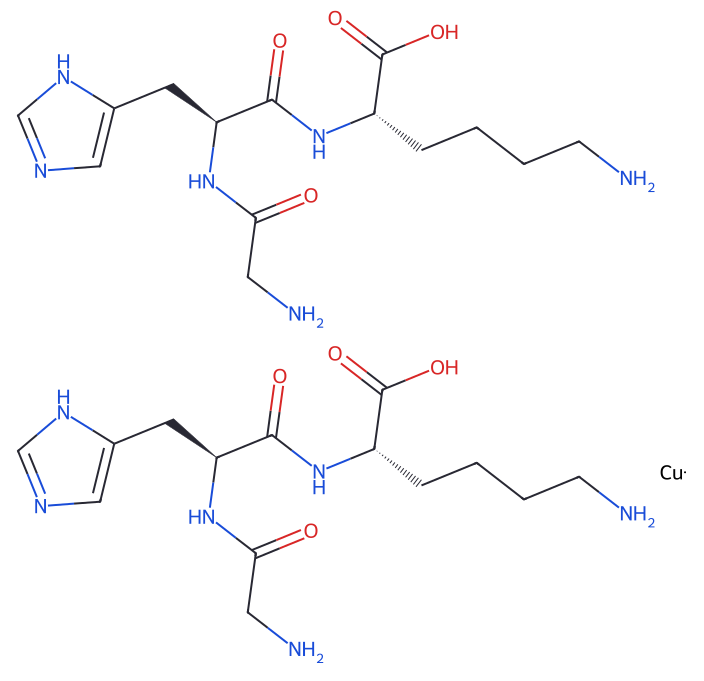
with a single copper centre.
PubChem CID 133697840
- Peptide sequence: Gly-His-Lys
- CAS number: 89030-95-5
- Molecular formula: C28H48CuN12O8
- Molecular weight: 744.3 g/mol
- Classification: Copper peptide complex
- Appearance: Blue to blue-violet powder — the colour is the copper
A note on stoichiometry
Most descriptions of GHK-Cu write it as one tripeptide to one copper ion, which would give a molecular weight near 402. The formula and mass above describe something different: two GHK units per copper centre, at 744.3 g/mol.
Both species are real. Copper coordination in solution is dynamic and depends on pH and on the ratio of peptide to metal, so GHK and copper form more than one complex and the literature reflects that. The 2:1 complex is a well-characterised species rather than an anomaly.
The practical point is that the two are easily distinguished: 744 against 402 is not a subtle difference. If you need to know which complex a given material is, the molecular weight answers it immediately — and a supplier who cannot say which one they are shipping does not know what they have.
The copper is the point
This is the most important thing to understand about the compound, and the thing most often glossed over.
GHK on its own is a tripeptide with modest activity. GHK-Cu is a copper delivery system. The peptide’s role is to bind copper with high affinity and specificity, hold it in a form that is soluble and non-toxic, and release it where it is needed. Free copper ions in tissue are damaging — they catalyse the production of reactive oxygen species — so a molecule that carries copper in a controlled form is doing something free copper salts cannot.
The histidine residue is central to that. Its imidazole ring is one of biology’s principal copper-binding groups, and the same chemistry appears at the copper-binding site of serum albumin. GHK is essentially a minimal version of a natural copper transport motif.
Where it comes from
GHK was identified in human plasma in the early 1970s by Loren Pickart, in work examining why plasma from younger donors supported liver cell function better than plasma from older donors. The active fraction turned out to be this tripeptide.
The observation that drove subsequent research is that its concentration in plasma declines markedly with age — reported to fall by roughly two thirds between early adulthood and later life. That decline, set against copper’s role in tissue maintenance, is the origin of essentially all the research interest in the molecule.
Mechanism of action
Copper is a required cofactor for several enzymes directly relevant to connective tissue:
- Lysyl oxidase cross-links collagen and elastin fibres. Without adequate copper it cannot function, and the resulting collagen is structurally weak.
- Superoxide dismutase in its copper-zinc form is a principal antioxidant enzyme.
- Cytochrome c oxidase is the terminal enzyme of the mitochondrial respiratory chain.
Delivering copper to tissue where these enzymes operate is the most mechanistically grounded account of what GHK-Cu does, and it connects directly to the collagen findings that make up much of the literature.
A separate and more expansive line of work reports that GHK influences the expression of a large number of genes, including those involved in tissue remodelling and inflammation. That work is genuinely interesting and considerably harder to interpret: broad transcriptional effects are easier to demonstrate than to attribute, and a molecule that changes hundreds of genes’ expression has not thereby been explained.
Areas of research investigation
Wound repair and collagen
The largest and best-supported body of work, including independent studies reporting stimulation of collagen synthesis in fibroblast culture.
Skin and hair
Research on dermal remodelling and on hair follicle biology, which is where the compound has seen the most commercial application.
Inflammation and antioxidant activity
Studies examining anti-inflammatory effects and the copper-dependent antioxidant enzymes noted above.
The shape of the evidence
As with several compounds here, a substantial proportion of the GHK-Cu literature comes from a single investigator — Pickart, who discovered the molecule and has published on it for five decades. That concentration warrants the same caution noted on other pages: a long publication record from one source is not the same as broad independent confirmation.
GHK-Cu is better placed than some. The collagen work in particular includes independent studies from other groups, and the underlying copper biochemistry — that lysyl oxidase requires copper, that copper-zinc SOD exists — is entirely uncontroversial and independent of any claim about this molecule. The mechanism has a foundation that does not rest on the compound’s own literature.
Related compounds in this catalogue
GHK-Cu appears in two of the blended products here alongside BPC-157, TB-500 and, in one case, KPV — combinations assembled around tissue repair.
AHK-Cu, also stocked, is a related copper tripeptide with alanine in place of glycine. It shares the copper-carrier principle and differs in its peptide component.
Handling, reconstitution and storage
Copper complexes have handling considerations that peptides alone do not:
- Avoid chelating agents. EDTA and similar compounds bind metal ions strongly and will strip copper from the complex, leaving free peptide and a copper chelate — neither of which is GHK-Cu. Check diluents and buffers for chelators.
- pH matters more than usual. Copper coordination depends on pH; strongly acidic conditions will dissociate the complex. Neutral or near-neutral diluents are appropriate.
- The colour is diagnostic. An intact copper complex is blue to blue-violet. Material that is white or off-white is not a copper complex, whatever the label says — a rare case where a visual check is genuinely informative.
- Lyophilised storage: sealed, refrigerated, protected from light. Freeze for long-term storage.
- Reconstitution: add diluent slowly down the vial wall and allow to dissolve undisturbed.
- Concentration: our peptide reconstitution calculator converts vial quantity, diluent volume and syringe size into concentration per unit.
Purity and analytical verification
This compound has a verification requirement that no other page in this catalogue describes, and it is routinely overlooked.
Peptide purity says nothing about the copper. HPLC separates and quantifies organic molecules. It will happily report 99% purity on material where the peptide is immaculate and the copper is absent, present in the wrong ratio, or partly present as a free ion rather than complexed. Peptide mass spectrometry has the same blind spot for the same reason.
Establishing that a batch is what it claims requires elemental analysis — ICP-MS or atomic absorption spectroscopy — to measure copper content directly, and ideally a stated stoichiometry so the measured copper can be checked against the expected ratio.
Three questions are therefore worth asking about any copper peptide: what is the peptide purity, what is the measured copper content, and which complex is it. A certificate answering only the first is describing a peptide, not a copper peptide.
We publish third-party certificates of analysis by batch.
References
- Pickart L, Thaler MM. Tripeptide in human serum which prolongs survival of normal liver cells and stimulates growth in neoplastic liver. Nature New Biology, 1973. PMID 4349963
- Maquart FX, Pickart L, Laurent M, et al. Stimulation of collagen synthesis in fibroblast cultures by the tripeptide-copper complex glycyl-L-histidyl-L-lysine-Cu2+. FEBS Letters, 1988. PMID 3169264
- Pickart L, Margolina A. Regenerative and protective actions of the GHK-Cu peptide in the light of the new gene data. International Journal of Molecular Sciences, 2018. PMID 29986520
Summary
GHK-Cu is a complex of the tripeptide glycyl-L-histidyl-L-lysine with copper(II), CAS 89030-95-5, molecular formula C28H48CuN12O8, molecular weight 744.3 g/mol — a two-peptide-to-one-copper complex, distinguishable by mass from the 1:1 form near 402. It occurs naturally in human plasma, where concentrations decline substantially with age, and functions as a controlled copper carrier rather than as a peptide with incidental metal content. Copper is a required cofactor for lysyl oxidase, which cross-links collagen, and that dependency is the most grounded explanation for the compound’s reported effects on tissue repair. Verifying it requires elemental analysis alongside peptide testing, because standard peptide methods cannot see the copper at all.
For laboratory research use only. Not for human consumption. This material is not a drug, food, or cosmetic and may not be sold or used for any purpose other than in vitro or non-human laboratory research.