
Overview
GHRP-2 — also known as pralmorelin and by the development code KP-102 — is a synthetic hexapeptide growth hormone secretagogue acting at the ghrelin receptor. It was developed as a successor to GHRP-6, and differs from it at only two of six positions, one of which accounts for most of the difference in behaviour.
It occupies an unusual position in this catalogue: of all the compounds here, it is the one that progressed furthest into formal clinical use, having been employed as a diagnostic agent rather than remaining purely a research tool.
Chemical identity
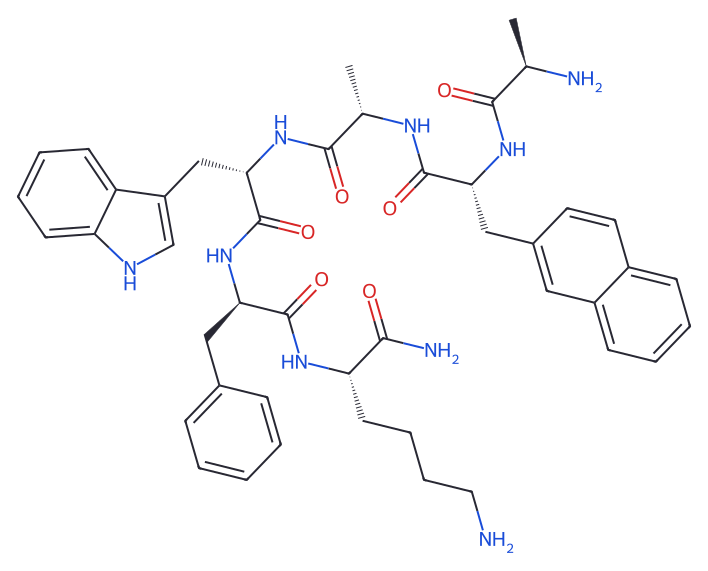
system at upper left is the residue that distinguishes it from GHRP-6.
PubChem CID 6918245
- Also known as: pralmorelin, KP-102, GHRP Kaken 100
- Sequence: D-Ala-D-2-Nal-Ala-Trp-D-Phe-Lys-NH2
- CAS number: 158861-67-7
- Molecular formula: C45H55N9O6
- Molecular weight: 818.0 g/mol
- Classification: Growth hormone secretagogue, GHS-R1a (ghrelin receptor) agonist
- Length: 6 residues, C-terminally amidated
What one residue changes
Set the two hexapeptides side by side and the relationship is obvious:
- GHRP-6: His – D-Trp – Ala – Trp – D-Phe – Lys-NH2
- GHRP-2: D-Ala – D-2-Nal – Ala – Trp – D-Phe – Lys-NH2
The last four residues are identical. The differences are at positions 1 and 2, and the consequential one is position 2, where D-tryptophan is replaced by D-2-naphthylalanine — an unnatural amino acid carrying a fused two-ring aromatic system in place of tryptophan’s indole.
That substitution is what the naming reflects: GHRP-2 is not a variant of a natural sequence but a designed molecule, and the naphthylalanine is the design. The larger, more rigid aromatic group binds the receptor pocket more tightly, which is the structural basis for the greater potency reported for GHRP-2 on a weight-for-weight basis.
The change is visible in the molecular formulae too. GHRP-2 carries nine nitrogen atoms against GHRP-6’s twelve — histidine’s imidazole ring accounts for two of the missing three, and naphthylalanine contributes no ring nitrogen where tryptophan’s indole contributes one.
Mechanism of action
GHRP-2 agonises GHS-R1a, the ghrelin receptor, signalling through phospholipase C and intracellular calcium to trigger growth hormone release from pituitary somatotrophs, while separately reducing somatostatin tone. This is the same receptor and the same pathway described in more detail on the GHRP-6 page, including the unusual history by which the receptor was characterised before its natural ligand was known.
Because it acts through the ghrelin receptor rather than the GHRH receptor, it is complementary to GHRH analogues such as Mod GRF 1-29, and the two classes are commonly studied in combination for that reason.
Use as a diagnostic agent
GHRP-2 is the compound in this catalogue with the most formal clinical history. Under the name pralmorelin it has been used in Japan as a diagnostic agent for growth hormone deficiency, administered as a provocative test: a controlled stimulus is given and the resulting growth hormone response measured, distinguishing a pituitary that can respond from one that cannot.
That application suits the compound’s properties. A diagnostic stimulus needs to be potent, to act quickly, and to produce a reproducible response — qualities that matter less for a compound intended for sustained effect but are exactly what a provocative test requires.
For research purposes the relevant consequence is that GHRP-2’s pharmacology has been characterised more thoroughly, and in more standardised conditions, than most secretagogues. That makes the published dose–response and time-course data unusually usable when designing experiments.
Selectivity, and what else the pituitary releases
Growth hormone secretagogues are not perfectly selective. The ghrelin receptor is expressed on more than one pituitary cell population and in hypothalamic regions with broader endocrine roles, and stimulating it can produce measurable effects on other pituitary hormones — cortisol and prolactin being the two most often reported.
The extent varies between compounds in this class and appears to be dose-dependent, with reports generally describing the effect as modest at lower stimulus levels and more evident as the stimulus increases. For a study measuring growth hormone as its endpoint this is a confound worth controlling for rather than assuming away, and it is a reason published work in this area typically measures several pituitary hormones rather than one.
How it compares with GHRP-6
- Potency: GHRP-2 is generally reported as the stronger GH secretagogue per unit mass.
- Appetite: GHRP-6 produces the more pronounced feeding response. Where appetite is a confound rather than an endpoint, that difference matters.
- Structure: identical C-terminal four residues; GHRP-2 substitutes D-2-naphthylalanine for D-tryptophan at position 2.
- Mass: 818.0 against 873.0 g/mol.
- Formal characterisation: GHRP-2 has the more developed clinical dossier.
Full detail on the other compound is on the GHRP-6 page.
Handling, reconstitution and storage
- Lyophilised storage: sealed, refrigerated, protected from light. Freeze for long-term storage.
- Light sensitivity is real but lower than GHRP-6’s. This sequence carries one tryptophan rather than two, and naphthylalanine is more photostable than indole. Keeping it dark remains good practice; it is simply less fragile in this specific respect than its predecessor.
- Reconstitution: add diluent slowly down the vial wall, allow to dissolve undisturbed, do not shake.
- After reconstitution: refrigerate, protect from light, minimise freeze–thaw cycles.
- Concentration: our peptide reconstitution calculator converts vial quantity, diluent volume and syringe size into concentration per unit.
Purity and analytical verification
The verification question specific to GHRP-2 concerns its unnatural residue.
D-2-naphthylalanine is not a standard proteinogenic amino acid and is more expensive than the alternatives. A synthesis substituting D-phenylalanine — a single benzene ring in place of the fused naphthalene — would produce a peptide 50 g/mol lighter, which mass spectrometry resolves easily. That is the useful check: the mass figure on a certificate should be consistent with 818 g/mol, not merely with “a hexapeptide”.
Standard HPLC purity applies alongside it, quantifying deletion sequences from incomplete coupling. Between the two, a certificate for this compound is genuinely informative — unlike peptides whose likely failure mode is a stereochemical error that leaves the mass unchanged.
We publish third-party certificates of analysis by batch.
References
- Bowers CY. Unnatural growth hormone-releasing peptide begets natural ghrelin. Journal of Clinical Endocrinology & Metabolism, 2001. PMID 11297568
- Pihoker C, Middleton R, Reynolds GA, et al. Diagnostic studies with intravenous and intranasal growth hormone-releasing peptide-2 in children of short stature. Journal of Clinical Endocrinology & Metabolism, 1995. PMID 7559885
- Kojima M, Hosoda H, Date Y, et al. Ghrelin is a growth-hormone-releasing acylated peptide from stomach. Nature, 1999. PMID 10604470
Summary
GHRP-2 (pralmorelin) is a synthetic hexapeptide growth hormone secretagogue, D-Ala-D-2-Nal-Ala-Trp-D-Phe-Lys-NH2, CAS 158861-67-7, molecular formula C45H55N9O6, molecular weight 818.0 g/mol. It agonises the ghrelin receptor GHS-R1a, sharing its mechanism and its C-terminal four residues with GHRP-6 but substituting an unnatural naphthylalanine at position 2 — the change underlying its greater reported potency. It has been used clinically in Japan as a diagnostic agent for growth hormone deficiency, which makes its pharmacology better characterised than most compounds of this class.
For laboratory research use only. Not for human consumption. This material is not a drug, food, or cosmetic and may not be sold or used for any purpose other than in vitro or non-human laboratory research.