
Overview
GHRP-6 — Growth Hormone Releasing Peptide-6 — is a synthetic hexapeptide that stimulates pituitary growth hormone release by activating the ghrelin receptor. It is one of the original compounds in its class and remains among the most-studied, both as a research tool for the growth hormone axis and, historically, as the compound that led to the discovery of ghrelin itself.
It acts on a completely different receptor from the GHRH analogues elsewhere in this catalogue, which is why the two classes are so often studied together.
Chemical identity
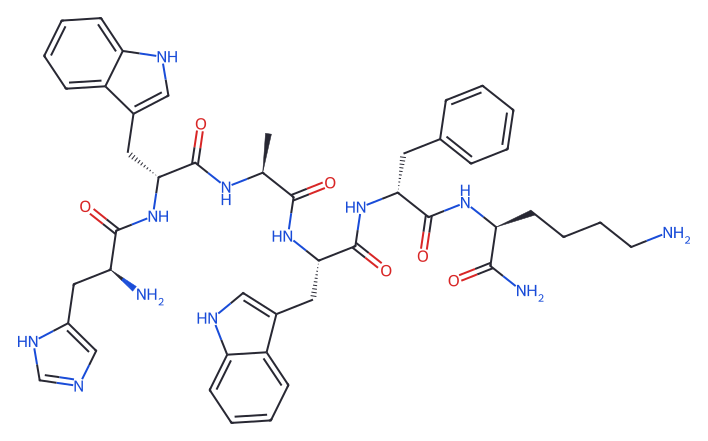
His-D-Trp-Ala-Trp-D-Phe-Lys-NH2.
PubChem CID 9919153
- Sequence: His-D-Trp-Ala-Trp-D-Phe-Lys-NH2
- CAS number: 87616-84-0
- Molecular formula: C46H56N12O6
- Molecular weight: 873.0 g/mol
- Classification: Growth hormone secretagogue, GHS-R1a (ghrelin receptor) agonist
- Length: 6 residues, C-terminally amidated
- Appearance: White lyophilised powder
Three features of that short sequence are deliberate. Two residues are D-enantiomers — D-tryptophan at position 2 and D-phenylalanine at position 5 — which protect the peptide from proteases that recognise L-amino acids. The C-terminus is amidated rather than left as a free acid, removing a negative charge and further slowing degradation. And the sequence carries two tryptophans, which matters for handling in a way covered below.
A compound that predates its own hormone
GHRP-6 has an unusual history that is worth knowing, because it explains why the compound exists at all.
It was developed in the early 1980s by Cyril Bowers and colleagues, derived from work on opioid peptide analogues rather than from any knowledge of a growth hormone secretagogue system. The peptide clearly released growth hormone, and clearly did so through a mechanism separate from GHRH — but nobody knew what it was binding to.
That question stayed open for over a decade. In 1996 the receptor was cloned and named the growth hormone secretagogue receptor, GHS-R — a receptor identified by the synthetic compounds that activated it, with no known natural ligand. It was, in the language of the field, an orphan.
The orphan was adopted in 1999, when Kojima and colleagues isolated an acylated peptide from stomach tissue that bound the receptor and released growth hormone. They named it ghrelin. The endogenous hormone was therefore discovered because synthetic compounds like GHRP-6 had been working on its receptor for fifteen years without anyone knowing whose receptor it was.
This is a textbook case of what is called reverse pharmacology — drug to receptor to hormone, rather than the usual order. It is also why GHRP-6 is sometimes described as a ghrelin mimetic despite predating ghrelin’s discovery by roughly two decades.
Mechanism of action
GHRP-6 is an agonist at GHS-R1a, the ghrelin receptor, a G-protein coupled receptor expressed in the pituitary and hypothalamus. Activation signals through phospholipase C and intracellular calcium release — a distinct pathway from the cyclic AMP signalling that GHRH receptor activation produces.
Two effects follow. Directly, somatotroph cells release growth hormone. Indirectly, the compound reduces somatostatin tone — somatostatin being the inhibitory signal that suppresses GH release between natural pulses. Lifting that brake amplifies the effect beyond what direct stimulation alone would produce.
Two pathways, one axis
This is the reason GHRPs and GHRH analogues are so frequently studied in combination, and the rationale is mechanistic rather than merely additive.
A GHRH analogue such as Mod GRF 1-29 acts at the GHRH receptor through cyclic AMP. GHRP-6 acts at the ghrelin receptor through calcium signalling, and separately reduces somatostatin inhibition. The two engage different receptors, different second messengers, and different arms of the regulatory system controlling the same output.
Because neither pathway saturates the other, combining them produces a response larger than either alone — the standard justification for pairing a GHRH analogue with a secretagogue in study designs. It also means the pairing is not redundant in the way that combining two GHRH analogues would be.
Appetite signalling
The characteristic that most distinguishes GHRP-6 from other secretagogues is its effect on feeding behaviour. Ghrelin is the body’s principal orexigenic signal — secreted by the stomach, rising before meals, acting on hypothalamic circuits to initiate hunger. An agonist at ghrelin’s receptor engages that circuitry alongside the growth hormone axis.
In animal studies this produces pronounced, reliable increases in food intake, and GHRP-6 is used as a research tool for appetite and feeding behaviour on that basis rather than only as a GH secretagogue. Among the commonly studied secretagogues, it is the one where this effect is most prominent — which makes it useful where appetite is the endpoint and a confound where it is not.
How it compares with GHRP-2
GHRP-2 is the closest comparator: same receptor, same class, developed as a successor. In broad terms the published characterisations describe GHRP-2 as the more potent GH secretagogue on a weight basis, and GHRP-6 as producing the more pronounced appetite response. Reported effects on other pituitary hormones such as cortisol and prolactin also differ between them.
Which of those properties is desirable depends entirely on the question being asked. A study of feeding behaviour and a study of GH release efficiency would reasonably choose differently.
Handling, reconstitution and storage
- Lyophilised storage: sealed, refrigerated, protected from light. Freeze for long-term storage.
- Protect from light in particular. Tryptophan is the most photosensitive of the amino acids, and this peptide contains two of them in a six-residue sequence — a third of the molecule. Light exposure is a more realistic degradation route here than for most peptides in this catalogue, and amber vials or foil are worth using rather than treating as optional.
- Reconstitution: add diluent slowly down the vial wall, allow to dissolve undisturbed, do not shake.
- After reconstitution: refrigerate, keep dark, minimise freeze–thaw cycles.
- Concentration: our peptide reconstitution calculator converts vial quantity, diluent volume and syringe size into concentration per unit.
Purity and analytical verification
A six-residue synthesis is comparatively straightforward, so gross deletion sequences are less of a concern here than in the thirty-residue peptides elsewhere in this catalogue. The more relevant question is oxidation.
Tryptophan oxidises readily, and each oxidation event adds sixteen mass units. On a 873 g/mol peptide with two tryptophans, that is a clearly resolvable shift — an oxidised variant appears as a distinct peak rather than hiding under the main one. A batch that has been stored badly or exposed to light will show it.
This makes GHRP-6 comparatively easy to verify: HPLC purity plus a mass figure is genuinely informative for this peptide, in a way it is not for compounds where the failure mode is a stereochemical error that leaves the mass unchanged.
We publish third-party certificates of analysis by batch.
References
- Bowers CY, Momany FA, Reynolds GA, Hong A. On the in vitro and in vivo activity of a new synthetic hexapeptide that acts on the pituitary to specifically release growth hormone. Endocrinology, 1984. PMID 6714155
- Howard AD, Feighner SD, Cully DF, et al. A receptor in pituitary and hypothalamus that functions in growth hormone release. Science, 1996. PMID 8688086
- Kojima M, Hosoda H, Date Y, et al. Ghrelin is a growth-hormone-releasing acylated peptide from stomach. Nature, 1999. PMID 10604470
Summary
GHRP-6 is a synthetic hexapeptide growth hormone secretagogue, His-D-Trp-Ala-Trp-D-Phe-Lys-NH2, CAS 87616-84-0, molecular formula C46H56N12O6, molecular weight 873.0 g/mol. It agonises the ghrelin receptor GHS-R1a, stimulating growth hormone release and reducing somatostatin tone through a pathway entirely separate from GHRH signalling — the reason the two classes are studied in combination. It produces the most pronounced appetite response of the commonly studied secretagogues, and it holds a particular place in endocrinology history: the receptor it activates was identified because of compounds like it, and ghrelin was discovered fifteen years later as the hormone that had been using that receptor all along.
For laboratory research use only. Not for human consumption. This material is not a drug, food, or cosmetic and may not be sold or used for any purpose other than in vitro or non-human laboratory research.