
Overview
Melanotan II is a synthetic cyclic heptapeptide analogue of alpha-melanocyte-stimulating hormone, studied as a non-selective agonist across the melanocortin receptor family. It was developed in the 1980s at the University of Arizona as part of a programme investigating melanocortin pharmacology, and it remains one of the most widely recognised peptides in this catalogue.
It is also the compound here with the most substantial record of documented adverse observations, which is covered directly below rather than omitted.
Chemical identity
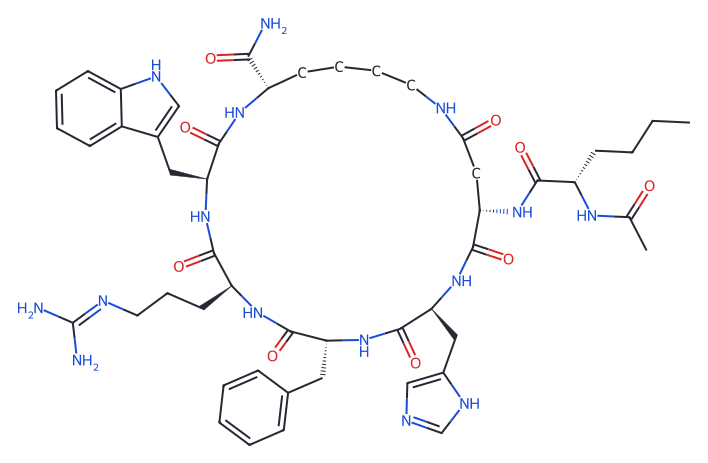
lactam bridge closing the cyclic core.
PubChem CID 92432
- Sequence: Ac-Nle-cyclo[Asp-His-D-Phe-Arg-Trp-Lys]-NH2
- CAS number: 121062-08-6
- Molecular formula: C50H69N15O9
- Molecular weight: 1024.2 g/mol
- Classification: Melanocortin receptor agonist, non-selective
- Appearance: White lyophilised powder
The prominent ring visible in the structure is the defining feature. An amide bond between the aspartate side chain and the lysine side chain closes the molecule into a macrocycle — a lactam bridge. Cyclisation locks the peptide into the conformation the receptor binds and makes it far more resistant to proteases than a linear chain, since exopeptidases have no free terminus to attack within the ring.
Two further modifications sit outside the ring: the N-terminus is acetylated and the C-terminus amidated, both removing charged termini and slowing degradation. The D-phenylalanine inside the ring is the usual protease-resistance substitution.
Where it comes from
Alpha-melanocyte-stimulating hormone is a thirteen-residue hormone derived from proopiomelanocortin, the same precursor that yields ACTH and beta-endorphin. Its best-known role is in pigmentation, but melanocortin signalling extends considerably further — into energy balance, sexual function, inflammation and exocrine secretion.
Structure–activity work established that the core message of alpha-MSH resides in a short central sequence, His-Phe-Arg-Trp. Melanotan II is built around that core: shortened, cyclised, and substituted for stability. It is a deliberately minimal, deliberately rigid version of the natural signal.
The melanocortin receptor family
There are five melanocortin receptors, and understanding which does what is essential to reading this compound’s literature:
- MC1R — melanocytes; melanin synthesis and pigmentation.
- MC2R — adrenal cortex; responds to ACTH rather than MSH peptides.
- MC3R — hypothalamus and elsewhere; energy homeostasis.
- MC4R — central nervous system; appetite regulation and sexual function.
- MC5R — exocrine glands.
Melanotan II activates MC1R, MC3R, MC4R and MC5R. That breadth is the central fact about the compound: its reported effects on pigmentation, on appetite and on sexual function are not side effects of one another but separate consequences of activating separate receptors, all engaged simultaneously because the molecule does not discriminate between them.
Melanotan I and PT-141: the selectivity story
Two related compounds in this catalogue exist because of that lack of selectivity, and the three together make the clearest illustration of receptor selectivity available here.
Melanotan I is the linear analogue, more selective for MC1R. Where the research question concerns pigmentation specifically, a compound that engages MC1R without the central receptors is the better tool.
PT-141 comes from the opposite direction. It is a metabolite-derived analogue of Melanotan II with markedly reduced MC1R activity and retained central activity — developed after observations during Melanotan II investigation indicated that the sexual-function effects were separable from the pigmentation effects. PT-141 is what that separation produced.
So the family maps onto the receptors: Melanotan I toward MC1R, PT-141 toward MC4R, and Melanotan II across the whole family. Which is appropriate depends entirely on which receptor the study is about.
Reported adverse observations
Melanotan II has a more substantial adverse-event literature than any other compound in this catalogue, and a summary that omitted it would be incomplete.
The commonly reported acute observations are nausea, flushing, spontaneous erections and darkening of existing pigmented lesions. Beyond these, the published case-report literature documents more serious events, including reports of changes in melanocytic naevi, cases of melanoma diagnosed in individuals with a history of use, and reports of rhabdomyolysis and of priapism.
Two caveats apply to reading that literature. Case reports establish association rather than causation, and the populations described obtained material outside any regulated supply, so composition and purity were generally unverified. But the volume of reports is itself informative, and the pigmentation-related findings have an obvious mechanistic plausibility given that MC1R activation is precisely what the compound does to melanocytes.
Handling, reconstitution and storage
- Lyophilised storage: sealed, refrigerated, protected from light. Freeze for long-term storage.
- More robust than most peptides here. Cyclisation, N-terminal acetylation and C-terminal amidation together make this an unusually stable molecule — there is no free terminus for exopeptidases and no flexible backbone to unfold.
- Light still matters. The single tryptophan is photosensitive, so keeping vials dark remains worthwhile.
- Reconstitution: add diluent slowly down the vial wall, allow to dissolve undisturbed, do not shake.
- Concentration: our peptide reconstitution calculator converts vial quantity, diluent volume and syringe size into concentration per unit.
Purity and analytical verification
This compound has a verification question that is specific, consequential and easy to check — which makes it a good one to ask about.
Cyclisation forms an amide bond between two side chains, and forming an amide bond releases a molecule of water. The cyclic peptide is therefore exactly 18 Da lighter than its uncyclised linear precursor. A batch in which cyclisation failed or ran incompletely contains linear material that is chemically similar, chromatographically close, and eighteen mass units heavier.
That difference is trivially resolvable by mass spectrometry — 18 Da out of 1,024 is a clear separation on any competent instrument. So for Melanotan II the mass figure on a certificate is not a formality: it is direct evidence that the macrocycle actually closed. Uncyclised material would lack the conformational rigidity the compound depends on for its receptor affinity and its protease resistance.
HPLC purity applies alongside, as always. We publish third-party certificates of analysis by batch.
References
- Dorr RT, Lines R, Levine N, et al. Evaluation of melanotan-II, a superpotent cyclic melanotropic peptide in a pilot phase-I clinical study. Life Sciences, 1996. PMID 8637402
- Hadley ME, Dorr RT. Melanocortin peptide therapeutics: historical milestones, clinical studies and commercialization. Peptides, 2006. PMID 16412534
- Cousen P, Colver G, Helbling I. Eruptive melanocytic naevi following melanotan injection. British Journal of Dermatology, 2009. PMID 19575725
Summary
Melanotan II is a synthetic cyclic heptapeptide analogue of alpha-MSH, Ac-Nle-cyclo[Asp-His-D-Phe-Arg-Trp-Lys]-NH2, CAS 121062-08-6, molecular formula C50H69N15O9, molecular weight 1,024.2 g/mol. A side-chain lactam bridge closes it into a macrocycle, conferring both conformational rigidity and protease resistance. It agonises MC1R, MC3R, MC4R and MC5R without selectivity, which is why its reported effects on pigmentation, appetite and sexual function are separate consequences of separate receptors rather than one effect and its side effects. Its adverse-event literature is the most substantial of any compound in this catalogue.
For laboratory research use only. Not for human consumption. This material is not a drug, food, or cosmetic and may not be sold or used for any purpose other than in vitro or non-human laboratory research.