
Overview
Bronchogen is a synthetic tetrapeptide, one of a series of short peptide “bioregulators” developed in Russia and associated with respiratory tissue. It belongs to the same research programme as Epithalon, and is structurally almost the same molecule.
We do not stock it. It is documented because the relationship between these compounds is worth setting out clearly, including the part that invites scepticism.
Chemical identity
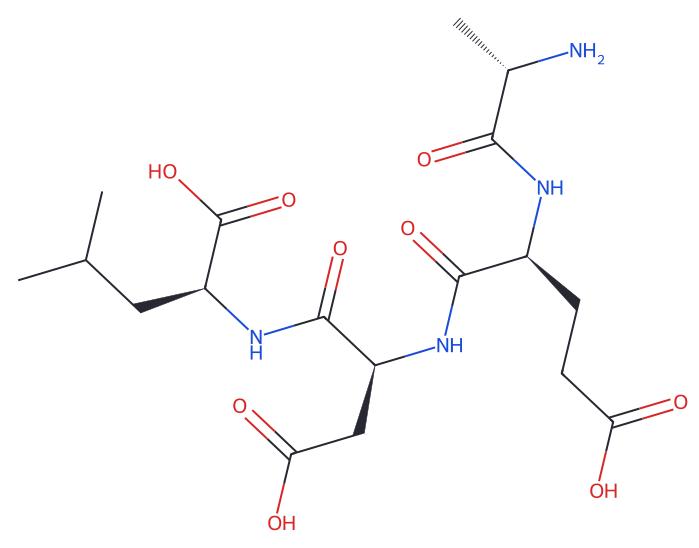
PubChem CID 11690869
- Sequence: Ala-Glu-Asp-Leu (AEDL)
- Molecular formula: C18H30N4O9
- Molecular weight: 446.5 g/mol
- Classification: Synthetic tetrapeptide bioregulator
One residue from Epithalon
The relationship is exact, and we checked it rather than assuming it:
- Epithalon: C14H22N4O9 — 390.35 g/mol — Ala-Glu-Asp-Gly
- Bronchogen: C18H30N4O9 — 446.50 g/mol — Ala-Glu-Asp-Leu
The formulae differ by C4H8, worth 56.15 g/mol. Replacing glycine with leucine changes residue mass by 56.11. Those agree within rounding, which confirms both the sequence assignment and the structural relationship independently of anything either compound’s literature claims.
Three of four residues are identical. The molecules are as similar as two distinct peptides can be.
The family, and why it warrants scrutiny
Bronchogen and Epithalon are part of a larger series developed within the same programme. As commonly listed, the pattern is:
- Epithalon — AEDG — assigned to the pineal gland
- Bronchogen — AEDL — assigned to bronchial tissue
- Cardiogen — AEDR — assigned to cardiac tissue
- Cortagen — AEDP — assigned to the cerebral cortex
Three shared residues, one variable position, and a different organ claimed for each.
That pattern should prompt questions rather than acceptance, and it is worth being explicit about why.
Tissue specificity in biology normally comes from molecular recognition — a receptor expressed in one tissue and not others, or a transporter, or a binding partner. It is a demanding property. For a four-residue peptide to be directed to a particular organ by the identity of its final amino acid, some mechanism would have to distinguish leucine from glycine at that position and route the molecule accordingly. No such mechanism has been identified for these compounds.
The alternative explanation is that the naming reflects the tissue each peptide was studied in rather than a tissue it is specific for. That would produce exactly the same set of names without requiring any specificity to exist.
Distinguishing between those two accounts would need direct comparison — the same peptide tested across several tissues, or several peptides tested in the same tissue, by investigators independent of the originating group. That work does not appear to be well represented in the accessible literature.
What is actually known
Less than for Epithalon, which is itself a compound whose evidence we describe as narrow.
The general observations that apply to the whole series apply here: the literature originates predominantly from a single research group, much of it is Russian-language and poorly indexed, studies are generally small, and independent replication is limited. Bronchogen has attracted considerably less attention than Epithalon even within that body of work.
The proposed mechanism for the series — that short peptides interact directly with DNA or chromatin to influence gene expression — is discussed on the Epithalon page. It remains a hypothesis rather than an established pathway, and it is the part of these compounds’ account most in need of independent structural and biochemical support.
Handling and storage
- Chemically robust. No cysteine, methionine or tryptophan — nothing oxidation-prone and nothing photosensitive. As with Epithalon, a short peptide of small residues is among the more forgiving materials to store.
- Water-soluble, given the two acidic residues, though leucine makes it somewhat less polar than Epithalon.
- Lyophilised storage: sealed, refrigerated; freeze for long-term storage.
- Reconstitution: add diluent slowly down the vial wall and allow to dissolve undisturbed.
Purity and analytical verification
A four-residue synthesis is trivial by the standards of this library, so deletion sequences are a minor concern and purity should be high.
The check worth making is identity against the related peptides, and it is straightforward because the family members differ substantially in mass despite differing by one residue:
- AEDG (Epithalon) — 390.4
- AEDL (Bronchogen) — 446.5
- AEDR (Cardiogen) — approximately 489.5
Those are separated by 56 and 43 g/mol respectively — large, unambiguous gaps on molecules of this size. A mass figure identifies which member of the series is in the vial without ambiguity, which matters given that they share three of four residues and are produced by the same routes.
As with KPV, note that a short peptide’s counterion is a meaningful fraction of vial mass, so net peptide content and gross mass differ.
References
Compound-specific literature for Bronchogen is very limited, and we could not identify primary sources we are confident enough to cite for it individually. The references below concern the peptide bioregulator series generally and should be treated as background rather than as evidence about this compound.
- Khavinson VKh. Peptides and ageing. Neuroendocrinology Letters, 2002. PMID 12374906
- Khavinson VKh, Malinin VV. Gerontological Aspects of Genome Peptide Regulation. Karger, 2005. (monograph; not indexed in PubMed)
Summary
Bronchogen is the synthetic tetrapeptide Ala-Glu-Asp-Leu, molecular formula C18H30N4O9, molecular weight 446.5 g/mol. It differs from Epithalon by a single residue, glycine replaced by leucine, a relationship we confirmed by checking the formula difference against the expected residue mass change. It belongs to a series of near-identical tetrapeptides each associated with a different organ, a pattern for which no mechanism of tissue specificity has been demonstrated and which more plausibly reflects where each peptide was studied than where it acts. Its compound-specific literature is very limited. We do not stock it.
This page is provided for research reference. Compounds described in this library are for laboratory research use only, are not drugs, foods or cosmetics, and may not be used for any purpose other than in vitro or non-human laboratory research.