
Overview
Ipamorelin is a synthetic pentapeptide growth hormone secretagogue acting at the ghrelin receptor. It arrived after the first-generation GHRPs and was built to address a specific criticism of them: that stimulating the ghrelin receptor tends to produce effects beyond growth hormone release.
The paper that introduced it was titled “Ipamorelin, the first selective growth hormone secretagogue”, which states the compound’s entire reason for existing in its title.
Chemical identity
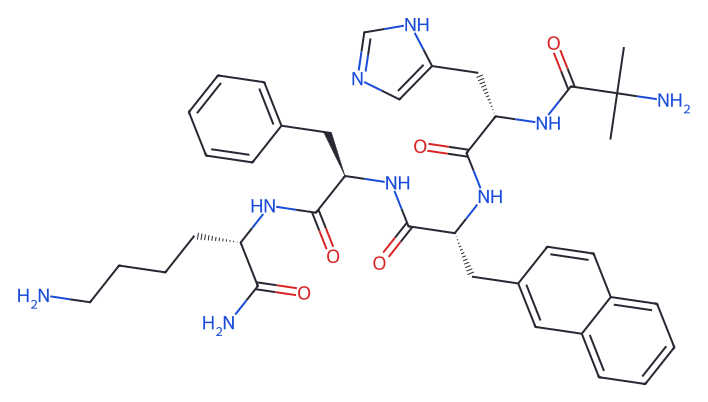
is the naphthylalanine residue.
PubChem CID 9831659
- Sequence: Aib-His-D-2-Nal-D-Phe-Lys-NH2
- CAS number: 170851-70-4
- Molecular formula: C38H49N9O5
- Molecular weight: 711.9 g/mol
- Classification: Growth hormone secretagogue, GHS-R1a (ghrelin receptor) agonist
- Length: 5 residues, C-terminally amidated
Two of those five residues are not standard amino acids. Aib — 2-aminoisobutyric acid — is the same residue used at position 8 of semaglutide, where its extra methyl group blocks enzymatic cleavage. D-2-naphthylalanine is the bulky aromatic residue that also distinguishes GHRP-2 from its predecessor. Ipamorelin borrows one element from each direction of secretagogue design.
The problem it was built to solve
The ghrelin receptor is not expressed only where growth hormone is made. It appears on more than one pituitary cell population and in hypothalamic regions with broader endocrine roles, and the first-generation compounds reflect that: stimulating the receptor with GHRP-6 or GHRP-2 can produce measurable movement in cortisol, prolactin and ACTH alongside the intended growth hormone response.
For a study measuring growth hormone, that is a confound. Cortisol in particular has wide metabolic effects of its own, so an experiment cannot cleanly attribute an outcome to growth hormone if cortisol moved as well.
Ipamorelin was developed against that specific requirement. Published characterisation describes it as producing growth hormone release comparable to the GHRPs while leaving cortisol, prolactin and ACTH substantially undisturbed at effective doses.
What “selective” means here
The claim is worth stating precisely, because it is often loosely repeated.
Ipamorelin is not selective in the sense of binding a different receptor. It agonises GHS-R1a, the same target as the other secretagogues here, through the same phospholipase C and calcium signalling. Its selectivity is functional — it is about which downstream outputs follow from that activation, not about which receptor is engaged.
Nor is the selectivity absolute. It is a matter of degree, and it is dose-dependent: comparisons describing minimal effects on other pituitary hormones refer to doses producing meaningful growth hormone release, not to any dose whatsoever.
The distinction matters for reading the literature. A study reporting cortisol changes at high doses is not contradicting the selectivity claim; it is describing where the claim’s boundary sits.
Mechanism of action
Ipamorelin agonises GHS-R1a on pituitary somatotrophs, triggering growth hormone release and reducing somatostatin tone. The receptor pharmacology and its history — the receptor was characterised before its natural ligand ghrelin was known — are covered on the GHRP-6 page.
Because it acts through the ghrelin receptor rather than the GHRH receptor, it is complementary to GHRH analogues such as Mod GRF 1-29, and the two classes are frequently paired in study designs for that reason.
Appetite, and where that leaves it
The other characteristic distinguishing ipamorelin from GHRP-6 is its comparatively modest effect on feeding behaviour. Since the ghrelin receptor is the body’s principal hunger signal, an agonist engaging it without producing strong appetite effects is not obvious, and this is part of the same functional selectivity.
Which compound is appropriate therefore depends on the question:
- GHRP-6 — strongest appetite response. Useful where feeding behaviour is the endpoint.
- GHRP-2 — most potent per unit mass for growth hormone release.
- Ipamorelin — cleanest endocrine profile. Useful where anything other than growth hormone would muddy the result.
Handling, reconstitution and storage
- Lyophilised storage: sealed, refrigerated, protected from light. Freeze for long-term storage.
- Less light-sensitive than GHRP-6. This sequence contains no tryptophan — naphthylalanine and phenylalanine are considerably more photostable than indole. Keeping vials dark remains sensible, but the specific fragility that makes GHRP-6 demanding does not apply.
- No oxidation-prone residues. No methionine, no cysteine.
- Reconstitution: add diluent slowly down the vial wall, allow to dissolve undisturbed, do not shake.
- Concentration: our peptide reconstitution calculator converts vial quantity, diluent volume and syringe size into concentration per unit.
Purity and analytical verification
There is a specific reason to care about verification for this compound, and it is commercial rather than chemical.
Ipamorelin’s value proposition is its selectivity. Anyone choosing it over GHRP-6 is not buying more potency — they are buying a cleaner endocrine profile. But selectivity is a pharmacological property that no certificate can measure directly. It follows from the molecule being the right molecule, and nothing else.
That places unusual weight on identity confirmation, and fortunately the two non-standard residues make identity easy to check. Both are more expensive than the standard amino acids that could replace them, and both substitutions would be plainly visible by mass:
- Substituting alanine for Aib would make the peptide 14 Da lighter.
- Substituting D-phenylalanine for D-2-naphthylalanine would make it 50 Da lighter.
Against 711.9 g/mol, either shift is unmissable on a competent instrument. A mass figure consistent with 711.9 confirms both unusual residues are present; a figure meaningfully below it does not. This is one of the compounds where a certificate genuinely answers the question that matters.
HPLC purity applies alongside, though a five-residue synthesis generates comparatively few deletion sequences.
We publish third-party certificates of analysis by batch.
References
- Raun K, Hansen BS, Johansen NL, et al. Ipamorelin, the first selective growth hormone secretagogue. European Journal of Endocrinology, 1998. PMID 9849822
- Gobburu JV, Agersø H, Jusko WJ, Ynddal L. Pharmacokinetic-pharmacodynamic modeling of ipamorelin, a growth hormone releasing peptide, in human volunteers. Pharmaceutical Research, 1999. PMID 10496658
Summary
Ipamorelin is a synthetic pentapeptide growth hormone secretagogue, Aib-His-D-2-Nal-D-Phe-Lys-NH2, CAS 170851-70-4, molecular formula C38H49N9O5, molecular weight 711.9 g/mol. It agonises the same ghrelin receptor as the GHRPs but was designed for functional selectivity — growth hormone release with substantially less movement in cortisol, prolactin and ACTH, and considerably less appetite stimulation than GHRP-6. That selectivity is a matter of degree and is dose-dependent rather than absolute. Two non-standard residues, Aib and D-2-naphthylalanine, define the molecule and make its identity straightforward to confirm by mass.
For laboratory research use only. Not for human consumption. This material is not a drug, food, or cosmetic and may not be sold or used for any purpose other than in vitro or non-human laboratory research.