
Overview
SLU-PP-332 is a synthetic small-molecule agonist of the estrogen-related receptors, developed in academic medicinal chemistry and studied in relation to mitochondrial function and exercise capacity. The name records its origin: it came out of work at Saint Louis University.
We do not stock it. It is documented because it illustrates a mechanism class that nothing else in this library represents, and because the popular account of it is worth correcting.
Chemical identity
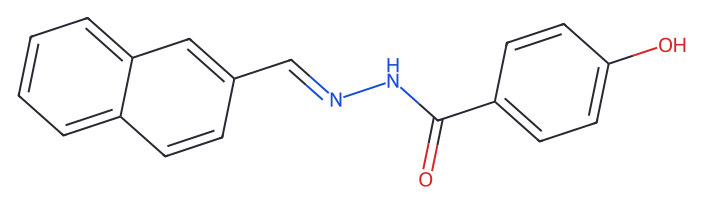
molecule, not a peptide.
PubChem CID 5338394
- CAS number: 303760-60-3
- Molecular formula: C18H14N2O2
- Molecular weight: 290.3 g/mol
- Classification: Small-molecule nuclear receptor agonist
At 290 g/mol it is roughly a fifteenth the mass of the larger peptides here and smaller even than KPV. The diagram above is the whole molecule, legible at a glance — a rarity in this catalogue.
A different kind of receptor
Almost every compound documented in this library acts on a cell-surface receptor. A peptide arrives at the outside of a cell, binds a protein spanning the membrane, and that protein passes a signal inward through second messengers — cyclic AMP, calcium, and so on. The peptide itself never enters the cell.
Nuclear receptors work differently. They sit inside the cell, and many bind DNA directly. A ligand small enough and lipophilic enough to cross the membrane binds the receptor in the cytoplasm or nucleus, and the receptor–ligand complex then acts on gene expression itself, switching transcription of target genes up or down.
There is no signalling cascade in between. The receptor is the transcription factor.
That difference explains why this compound is a small molecule rather than a peptide. A peptide cannot readily cross a cell membrane — the problem described for NAD+, which fails to enter cells for the same reason. Reaching a target inside the cell requires a molecule built to get there, and 290 g/mol of largely hydrocarbon structure is what that looks like.
The estrogen-related receptors this compound targets are involved in regulating mitochondrial biogenesis and oxidative metabolism — the machinery cells use to generate energy aerobically. That is the connection to exercise physiology.
The “exercise in a pill” problem
SLU-PP-332 received considerable press attention on the strength of published work reporting increased running capacity in mice, framed in coverage as exercise without exercising.
What the research reports is narrower than that framing. The findings concern mice, specific metabolic and performance endpoints, and short study durations. Exercise in an intact animal produces effects across the cardiovascular system, skeletal muscle, bone, metabolism, the nervous system and immune function; increasing treadmill endurance in a mouse reproduces a fraction of that at most.
There is nothing wrong with the underlying research — a compound that increases aerobic capacity through a defined mechanism is a legitimate and interesting result. The gap is between what was measured and what was reported, and it is wide.
Anyone reading about this compound should go to the primary literature, note what was actually measured, and treat the popular framing as what it is.
The state of the evidence
Early. This is a recent compound with a small published literature, predominantly preclinical, from a limited number of groups. There is no long-term data, no substantial independent replication, and nothing approaching clinical characterisation.
Its interest is as a pharmacological tool for studying its receptor family, and that is the frame in which the literature should be read.
A note on confidence: the identity data above is verified — CAS, formula and structure all cross-check against the chemical registry. Our confidence in the pharmacological detail is lower than for most pages in this library, because the literature is recent, sparse, and in an area where the nuclear receptor nomenclature is easy to confuse. Verify the receptor pharmacology against primary sources before relying on it.
Handling and storage
Small-molecule handling rather than peptide handling applies, as with 5-Amino-1MQ:
- No denaturation risk. There is no folded structure, so shaking, foaming and freeze–thaw cycles are not the concerns they are for peptides.
- Solubility differs. Unlike the water-soluble peptides here, a lipophilic small molecule may require an organic co-solvent such as DMSO. Check before assuming aqueous preparation.
- Storage: sealed, dry, protected from light.
Purity and analytical verification
Small-molecule verification differs from peptide verification in the way described for 5-Amino-1MQ, and the point applies with more force here.
Mass spectrometry is weak evidence of identity for a small molecule. Many structures share the formula C18H14N2O2, and an isomer with substituents in different positions would be indistinguishable by mass while being a different compound. NMR is the definitive identity test, because it resolves connectivity rather than composition.
For a recent compound with limited commercial availability, that matters more than usual: there is less established supply, fewer reference standards, and correspondingly more room for material to be something other than what the label says. A certificate offering HPLC purity and a mass figure establishes that the material is pure and has the right formula — not that it is the right structure.
References
Confidence in the pharmacological literature for this compound is lower than for most pages here.
- Billon C, Sitaula S, Banerjee S, et al. Synthetic ERRα/β/γ agonist induces an ERRα-dependent acute aerobic exercise response and enhances exercise capacity. ACS Chemical Biology, 2023. PMID 36988910
Summary
SLU-PP-332 is a synthetic small-molecule nuclear receptor agonist, CAS 303760-60-3, molecular formula C18H14N2O2, molecular weight 290.3 g/mol — the smallest compound in this library and one of the few that is not a peptide. It acts on estrogen-related receptors, which sit inside the cell and regulate transcription directly rather than signalling through a membrane receptor, and which govern mitochondrial and oxidative metabolism. Reported effects on exercise capacity in mice were widely described as exercise in a pill, a characterisation that considerably exceeds what was measured. The evidence base is early and sparse, and the pharmacological detail on this page warrants independent verification. We do not stock it.
This page is provided for research reference. Compounds described in this library are for laboratory research use only, are not drugs, foods or cosmetics, and may not be used for any purpose other than in vitro or non-human laboratory research.