
Overview
Glutathione is a tripeptide found in essentially every cell of every animal, plant and micro-organism, typically at millimolar concentration — far higher than most biological molecules. It is central to cellular redox balance and to the detoxification pathways of the liver.
We do not stock it. It is documented because it is structurally unlike anything else in this library and because it illustrates a problem that recurs with intracellular molecules.
Chemical identity
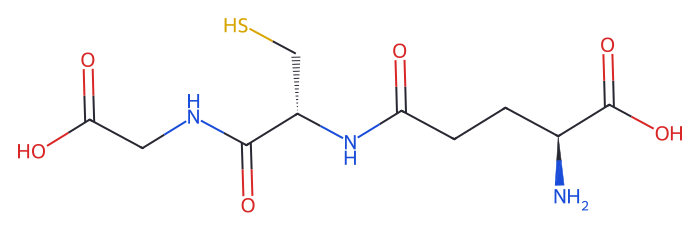
on the central cysteine is where the chemistry happens.
PubChem CID 124886
- Also known as: GSH, reduced glutathione, γ-Glu-Cys-Gly
- Sequence: γ-glutamyl-cysteinyl-glycine
- CAS number: 70-18-8
- Molecular formula: C10H17N3O6S
- Molecular weight: 307.33 g/mol
- Classification: Tripeptide thiol, intracellular antioxidant
The gamma bond
Glutathione is a peptide, but not an ordinary one, and the difference is worth understanding because it explains almost everything else about the molecule.
In every other peptide in this library, residues are joined backbone to backbone: the alpha-carboxyl of one amino acid bonds to the alpha-amino group of the next. That is what a peptide bond means, and it is what peptidases recognise.
In glutathione the first linkage is different. Glutamate is joined to cysteine through its side-chain carboxyl — the gamma position — not through its backbone. The molecule is written γ-Glu-Cys-Gly for exactly that reason.
The consequence is that ordinary peptidases cannot cleave it. They are built to recognise alpha-linkages, and the gamma bond is not one. Only a specific enzyme, gamma-glutamyl transpeptidase, can break it.
That is why a cell can maintain glutathione at millimolar concentration in a cytoplasm full of proteolytic machinery. The molecule is chemically invisible to almost all of it — a natural solution to the stability problem that the synthetic peptides in this library address with D-amino acids, amidation and cyclisation.
What it does
Nearly all of glutathione’s activity comes from one atom: the sulfur on the central cysteine.
A thiol group readily gives up a hydrogen and forms bonds with other sulfurs, which makes it a good reducing agent and a good nucleophile. Both properties are used:
- Antioxidant defence. Glutathione peroxidase uses glutathione to reduce hydrogen peroxide and lipid peroxides to harmless products, neutralising reactive oxygen species before they damage other molecules.
- Detoxification. Glutathione S-transferases attach glutathione to electrophilic compounds — many drug metabolites and environmental toxins — making them water-soluble and easier to excrete. This is a major arm of phase II liver metabolism.
- Protein thiol maintenance. Glutathione keeps cysteine residues in other proteins in their reduced state, preserving structures that depend on it.
The GSH/GSSG couple
When glutathione reduces something, it is itself oxidised: two molecules join through a disulphide bond to form GSSG, oxidised glutathione. An enzyme, glutathione reductase, converts GSSG back to two GSH using NADPH.
The ratio between the two forms is one of the standard measures of a cell’s redox state. Healthy cells maintain glutathione overwhelmingly in the reduced form; a shifted ratio indicates oxidative stress. Much of the research literature involving glutathione is measuring that ratio rather than administering the molecule.
The parallel with NAD+ is close: both are small molecules existing as a redox pair whose ratio reports on cellular metabolic state, and both are recycled rather than consumed in that role.
Why supplying it from outside is complicated
Glutathione is made inside cells, in two enzymatic steps from glutamate, cysteine and glycine. Cysteine availability is usually the limiting factor.
Supplying the finished molecule from outside runs into difficulties that mirror those described for NAD+. Glutathione is charged and hydrophilic, so it does not readily cross membranes; extracellular glutathione is substantially broken down by gamma-glutamyl transpeptidase on cell surfaces — the one enzyme that can cleave it — and the constituent amino acids are then taken up and reassembled inside.
So administered glutathione may function largely as a delivery vehicle for cysteine rather than as intact glutathione reaching its site of action. That is why a good deal of research uses precursors instead — N-acetylcysteine being the common example — which supply the limiting amino acid and let the cell do the synthesis.
None of this means extracellular glutathione does nothing. It means the mechanism is less direct than the name suggests, and it is worth knowing before designing an experiment around it.
Handling and storage
Glutathione is chemically reactive by design, and handling has to account for that.
- It oxidises readily in solution. Air, alkaline pH and trace metal ions all accelerate conversion to GSSG. Prepare solutions fresh where the work allows, keep them slightly acidic, and minimise air exposure.
- Trace metals matter. Copper and iron catalyse thiol oxidation efficiently. Use good-quality water.
- Solid storage: sealed, cool and dry. The powder is considerably more stable than the solution.
- No denaturation risk. There is no folded structure, so shaking is irrelevant — unlike almost everything else in this library.
Purity and analytical verification
Glutathione is a long-established commodity biochemical with pharmacopoeial standards and validated methods, so the general analytical picture is straightforward.
The compound-specific check is oxidation state, and it is unusually clean:
- GSH (reduced, what you want) — 307.33 g/mol
- GSSG (oxidised dimer) — 612.64 g/mol, being two GSH joined by a disulphide, less two hydrogens
The two differ by a factor of two in mass. Any oxidised material is a completely distinct species, trivially separated by chromatography and unmistakable by mass. A certificate for reduced glutathione should report GSSG content, and a supplier who does not distinguish the two is not distinguishing the active form from the spent one.
This is the same kind of check as the 340 nm test described for NAD+: for redox-active molecules, oxidation state is a distinct question from purity, and it is the one that determines whether the material does anything.
References
- Meister A, Anderson ME. Glutathione. Annual Review of Biochemistry, 1983. PMID 6137189
- Wu G, Fang YZ, Yang S, et al. Glutathione metabolism and its implications for health. Journal of Nutrition, 2004. PMID 14988435
- Forman HJ, Zhang H, Rinna A. Glutathione: overview of its protective roles, measurement, and biosynthesis. Molecular Aspects of Medicine, 2009. PMID 18796312
Summary
L-Glutathione is the tripeptide γ-glutamyl-cysteinyl-glycine, CAS 70-18-8, molecular formula C10H17N3O6S, molecular weight 307.33 g/mol. Its first linkage is a gamma bond through glutamate’s side chain rather than a normal backbone peptide bond, which makes it resistant to ordinary peptidases and allows cells to maintain it at millimolar concentration. The thiol on its central cysteine drives antioxidant defence, phase II detoxification and protein thiol maintenance, cycling between reduced GSH and oxidised GSSG. Delivering it from outside the cell is complicated by poor membrane permeability and surface degradation, so it may act largely as a cysteine source. We do not stock it.
This page is provided for research reference. Compounds described in this library are for laboratory research use only, are not drugs, foods or cosmetics, and may not be used for any purpose other than in vitro or non-human laboratory research.