
Overview
Epithalon — also written Epitalon, Epithalone, or Epithalamin, and referred to in the literature by its amino acid sequence AEDG (Ala-Glu-Asp-Gly) — is a synthetic tetrapeptide developed as a defined-sequence analogue of a pineal gland extract. It is one of the most frequently studied compounds in the “short peptide bioregulator” literature and is used in laboratory research investigating telomerase activity, circadian signalling, and biomarkers of cellular ageing in preclinical models.
The original extract, epithalamin, was a mixture isolated from bovine pineal tissue. Epithalon was synthesised to reproduce its proposed active fragment as a single, reproducible four-residue peptide — which is why nearly all modern work refers to the synthetic tetrapeptide rather than the extract.
Chemical identity
Epithalon is a linear tetrapeptide with free N- and C-termini. Its small size and high polarity distinguish it from the larger peptides more commonly encountered in research settings.
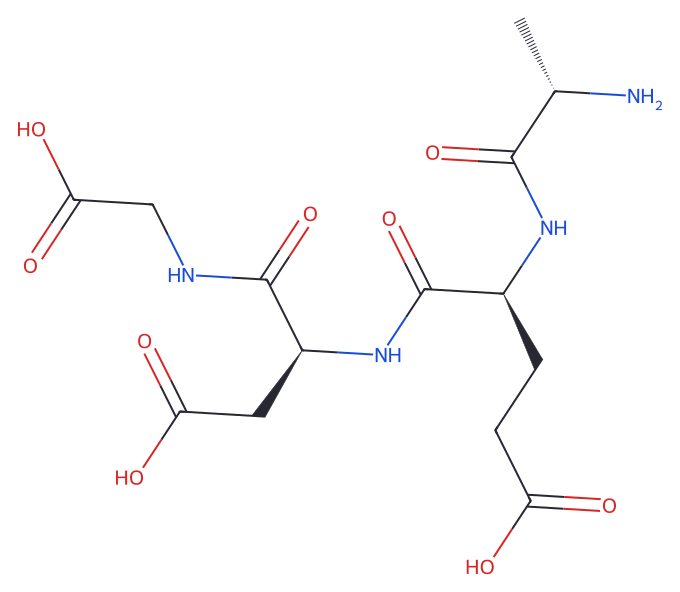
glutamic acid, aspartic acid, glycine.
PubChem CID 219042
- Sequence: Ala-Glu-Asp-Gly (AEDG)
- CAS number: 307297-39-8
- Molecular formula: C14H22N4O9
- Molecular weight: 390.35 g/mol
- Classification: Synthetic tetrapeptide / peptide bioregulator
- Appearance: White lyophilised powder
- Solubility: Readily soluble in water and bacteriostatic water
At 390.35 g/mol, Epithalon is roughly one quarter the mass of BPC-157 and an order of magnitude smaller than peptides such as Tesamorelin. Two of its four residues (glutamic and aspartic acid) carry acidic side chains — visible above as the two –COOH groups — giving the molecule a strongly negative net charge at neutral pH and accounting for its high aqueous solubility.
Mechanism of action under investigation
The mechanism most often associated with Epithalon in published work is induction of telomerase activity. Telomerase is the ribonucleoprotein enzyme that extends telomeres — the repeated DNA sequences capping chromosome ends, which shorten with successive cell divisions in most somatic cell types.
Khavinson and colleagues reported that Epithalon induced telomerase activity and telomere elongation in cultured human somatic cells, and proposed that short peptides of this kind may interact directly with DNA or chromatin to modulate gene expression. That proposed epigenetic mechanism — small peptides binding regulatory regions and altering transcription — remains a hypothesis rather than an established pathway, and it is the part of the Epithalon literature most in need of independent replication.
A second line of investigation concerns the pineal gland and circadian regulation. Because Epithalon derives from a pineal extract, several studies have examined its relationship to melatonin secretion and circadian rhythm in animal models, particularly in aged animals where melatonin rhythm amplitude is reduced.
Areas of research investigation
Telomere biology
The most cited work concerns telomerase induction and telomere length in cultured human fibroblasts. This is the basis for most interest in Epithalon as a research tool in cellular ageing.
Lifespan and ageing biomarkers in rodents
Anisimov and colleagues examined the effect of Epitalon on lifespan, ageing biomarkers, and spontaneous tumour incidence in female mice, reporting changes in several measured parameters relative to controls. Related work from the same group examined effects on oestrous function and free-radical measures in rats.
Circadian and neuroendocrine signalling
Studies have investigated effects on melatonin rhythm and pineal function in aged animals, consistent with the compound’s origin as a pineal extract fragment.
Antioxidant and immune parameters
Several reports describe changes in antioxidant enzyme activity and immune markers in laboratory animals, though these endpoints are measured less consistently across studies than the telomerase work.
Limitations of the current evidence
Any honest summary of Epithalon has to address the shape of its evidence base, because it differs from that of better-characterised research peptides:
- Concentrated authorship. A large share of the published work originates from a single research group at the St Petersburg Institute of Bioregulation and Gerontology. Independent replication by unaffiliated laboratories is limited.
- Publication venue and access. Much of the literature appears in Russian-language journals or in translation, and older studies are frequently unavailable in full text, which makes methodological appraisal difficult.
- Study scale. Reported animal and human studies are generally small, and several lack the controls or blinding expected of contemporary work.
- Mechanistic gap. The proposed direct peptide–DNA interaction has not been established through the structural and biochemical evidence that would normally support such a claim.
None of this makes Epithalon uninteresting as a research subject — the telomerase findings are precisely why it continues to attract attention. It does mean that results reported in the existing literature should be treated as preliminary, and that experimental designs should not assume the published effects will replicate.
Reported observations in laboratory models
Across published animal studies, Epithalon is generally described as well tolerated at the doses examined, with few adverse observations reported. Where effects have been noted, they include local irritation at the injection site and transient behavioural changes such as altered activity or feeding. Reported observations vary with dose, schedule, and species, and the small scale of most studies limits what can be concluded about tolerability.
Study parameters reported in the literature
The following describes protocols used in published research, provided for context when reviewing that literature. It is not a recommendation, and it is not guidance for use in humans.
Published rodent studies have typically administered Epithalon parenterally in short courses — commonly consecutive-day cycles separated by longer intervals — rather than continuously. Doses in the animal literature are reported per kilogram of body mass and vary substantially between studies. Because Epithalon is cleared rapidly and has a short plasma half-life, cyclical schedules are the norm across the published work.
Researchers designing experiments should derive parameters from the specific studies they intend to build on rather than from generalised figures, and should account for species, route, and formulation differences.
Handling, reconstitution and storage
Epithalon ships as a lyophilised powder and is stable in that form. Standard laboratory practice for short peptides applies:
- Lyophilised storage: keep sealed and protected from light. Refrigerated storage is suitable for shorter periods; freezing extends stability for long-term storage.
- Reconstitution: introduce diluent slowly against the vial wall rather than directly onto the powder, and allow the solid to dissolve without agitation. Do not shake — mechanical stress and foaming degrade peptides.
- After reconstitution: refrigerate and protect from light. Aqueous solutions of short peptides are considerably less stable than the lyophilised form, and acidic residues make Epithalon sensitive to repeated freeze–thaw cycles. Aliquot if the material will be drawn on repeatedly.
- Concentration: our peptide reconstitution calculator will work out concentration per unit from vial quantity, diluent volume, and syringe size.
Purity and analytical verification
Epithalon’s short sequence makes it comparatively straightforward to synthesise, which is exactly why analytical verification matters: the barrier to entry is low and material quality varies widely between suppliers. Two figures are worth checking on any certificate of analysis.
HPLC purity quantifies the proportion of the sample that is the intended peptide, with the remainder typically consisting of truncated sequences and synthesis by-products. Mass spectrometry confirms molecular identity — for Epithalon, a measured mass consistent with 390.35 g/mol confirms the correct tetrapeptide rather than a deletion sequence of similar retention time.
We publish third-party certificates of analysis by batch. If a supplier cannot produce both figures for the specific lot you are buying, purity claims on the product page are unverifiable.
References
The following are starting points in the primary literature.
- Khavinson VKh, Bondarev IE, Butyugov AA. Epithalon peptide induces telomerase activity and telomere elongation in human somatic cells. Bulletin of Experimental Biology and Medicine, 2003. PMID 12937682
- Anisimov VN, Khavinson VKh, et al. Effect of Epitalon on biomarkers of aging, life span and spontaneous tumor incidence in female Swiss-derived SHR mice. Biogerontology, 2003. PMID 14501183
- Khavinson VKh, Morozov VG. Peptides of pineal gland and thymus prolong human life. Neuroendocrinology Letters, 2003. PMID 14523363
- Anisimov VN, et al. Inhibitory effect of the peptide Epitalon on the development of spontaneous mammary tumors in HER-2/neu transgenic mice. International Journal of Cancer, 2002. PMID 12209581
Summary
Epithalon (Epitalon, AEDG) is a synthetic tetrapeptide, CAS 307297-39-8, molecular formula C14H22N4O9, molecular weight 390.35 g/mol, developed as a defined-sequence analogue of a pineal extract. It is studied primarily for reported effects on telomerase activity and telomere length, and secondarily for circadian, antioxidant and immune endpoints in preclinical models. Its evidence base is real but narrow — concentrated in a single research group, mostly small in scale, and thin on independent replication — which makes it a compound of genuine research interest and one where published findings should be treated as preliminary.
For laboratory research use only. Not for human consumption. This material is not a drug, food, or cosmetic and may not be sold or used for any purpose other than in vitro or non-human laboratory research.