
Overview
Nicotinamide adenine dinucleotide is a coenzyme present in every living cell and one of the most fundamental molecules in biochemistry. NAD+ is its oxidised form. It is studied in research on cellular metabolism, DNA repair signalling, and the biology of ageing.
It sits oddly in a peptide catalogue, and that is worth stating plainly: it is not a peptide, not a protein fragment, and does not act on a receptor. It is a dinucleotide — two nucleotides joined through their phosphate groups — and it works as chemistry rather than as signalling.
Chemical identity
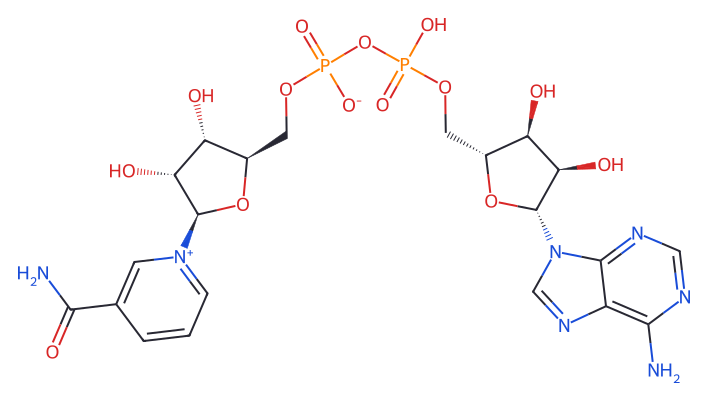
nicotinamide at one end, adenine at the other, two phosphates in the middle.
PubChem CID 5892
- Full name: β-Nicotinamide adenine dinucleotide, oxidised form
- CAS number: 53-84-9
- Molecular formula: C21H27N7O14P2
- Molecular weight: 663.43 g/mol
- Classification: Dinucleotide coenzyme
- Appearance: White to off-white powder; hygroscopic
The structure is legible in the diagram: a nicotinamide ring at one end, adenine at the other, joined by two ribose sugars and a diphosphate bridge. Those two phosphates carry negative charges at physiological pH, which is central to how the molecule behaves — and to its main limitation.
Two different jobs
Most descriptions cover the first role and omit the second, which is unfortunate, because the second is the reason anyone is interested in NAD+ levels at all.
As a recycled electron carrier
The classical role. NAD+ accepts a pair of electrons during metabolic reactions, becoming NADH, and gives them up again elsewhere, returning to NAD+. It is the primary electron shuttle of glycolysis and the citric acid cycle, and it drives oxidative phosphorylation.
In this role the molecule is not consumed. It cycles between two states indefinitely, and a cell needs only enough to keep the cycle turning.
As a consumed substrate
NAD+ is also a raw material for several classes of enzyme that cleave it and use the pieces:
- Sirtuins remove acetyl groups from proteins, consuming NAD+ for each reaction.
- PARPs build polymers onto proteins in response to DNA damage, consuming NAD+ heavily when damage is extensive.
- CD38 and related enzymes degrade NAD+ as part of calcium signalling.
Here the molecule is destroyed and must be resynthesised. This is where the connection to ageing comes from: NAD+ declines with age across tissues, and the leading explanations concern the balance between consumption by these enzymes and the salvage capacity that rebuilds it.
The permeability problem
This is the most important thing to understand about administering NAD+ directly, and it is usually left unsaid.
NAD+ is large by small-molecule standards and carries multiple negative charges from its phosphate groups. Cell membranes are built to keep exactly that kind of molecule out. Intact NAD+ does not cross them readily.
What happens instead is that extracellular NAD+ encounters enzymes on the cell surface — CD38 among them — which break it down. The fragments, principally nicotinamide and nicotinamide riboside, are small and uncharged enough to enter cells, where the salvage pathway rebuilds them into NAD+.
So the reasonable reading of administered NAD+ is that much of its effect is delivered by its own breakdown products acting as precursors, rather than by intact molecules arriving where they are needed. That is a real mechanistic caveat, and it is why a great deal of published research uses precursors — nicotinamide mononucleotide and nicotinamide riboside — rather than NAD+ itself.
Precursors and the salvage pathway
Cells make NAD+ mostly by recycling rather than building from scratch. The salvage pathway takes nicotinamide, converts it to nicotinamide mononucleotide, and then to NAD+. Nicotinamide riboside enters the same pathway one step earlier.
This is where a compound elsewhere in this catalogue connects. 5-Amino-1MQ inhibits NNMT, the enzyme that methylates nicotinamide and diverts it out of the salvage pathway for excretion. Blocking that diversion leaves more nicotinamide available for recycling into NAD+.
The two approaches are therefore mechanistically distinct: supplying more raw material, versus reducing the leak. Studies comparing or combining them are examining the same pool from opposite directions.
Areas of research investigation
Ageing and cellular senescence
The largest area, following from the observed decline in NAD+ with age and its role as sirtuin substrate.
Mitochondrial function
The NAD+/NADH ratio governs the rate of several metabolic pathways, making it a natural focus for work on cellular energetics.
DNA damage response
PARP enzymes consume NAD+ when repairing DNA damage, creating a link between genomic stress and metabolic state.
Handling, reconstitution and storage
NAD+ is not a peptide and the usual peptide guidance does not transfer. It has its own specific vulnerabilities.
- Hygroscopic. The powder draws moisture from air readily, and absorbed water accelerates degradation. Keep tightly sealed; allow a cold vial to reach room temperature before opening, or condensation will form inside it.
- Unstable in solution, particularly at alkaline pH. Unlike a lyophilised peptide, which is reasonably stable once dissolved and refrigerated, NAD+ in water degrades measurably. Prepare solutions fresh where the work allows it.
- Protect from light.
- Dry storage: sealed, cold and dry. Desiccated storage is worth the effort here in a way it is not for most compounds in this catalogue.
- Shaking is not a concern. There is no folded structure to denature — the caution that applies to every peptide here does not apply to this molecule.
- Concentration: our reconstitution calculator handles the arithmetic, though note the molecular weight differs greatly from the peptides.
Purity and analytical verification
NAD+ is a long-established commodity biochemical rather than a research peptide, which changes the analytical picture: reference standards exist, methods are standardised, and there is no exotic modification to get wrong.
There is, however, an elegant and specific check available for this molecule that is worth knowing.
NADH absorbs strongly at 340 nm. NAD+ does not. The reduced and oxidised forms are otherwise similar and share a chromatographic profile, but their ultraviolet spectra differ sharply at that one wavelength — a difference so reliable that essentially every enzyme assay in biochemistry is built on it.
A sample claiming to be the oxidised form should show little absorbance at 340 nm. Meaningful absorbance there indicates reduced material, whether from partial reduction in manufacture or degradation in storage. It is a fast, unambiguous test that requires only a spectrophotometer.
Beyond that, HPLC purity is the standard measure, with nicotinamide and ADP-ribose as the expected degradation products.
We publish third-party certificates of analysis by batch.
References
- Verdin E. NAD+ in aging, metabolism, and neurodegeneration. Science, 2015. PMID 26785480
- Rajman L, Chwalek K, Sinclair DA. Therapeutic potential of NAD-boosting molecules: the in vivo evidence. Cell Metabolism, 2018. PMID 29514064
- Covarrubias AJ, Perrone R, Grozio A, Verdin E. NAD+ metabolism and its roles in cellular processes during ageing. Nature Reviews Molecular Cell Biology, 2021. PMID 33353981
Summary
NAD+ is nicotinamide adenine dinucleotide in its oxidised form, CAS 53-84-9, molecular formula C21H27N7O14P2, molecular weight 663.43 g/mol — a coenzyme rather than a peptide. It serves two distinct roles: a recycled electron carrier that is never used up, and a consumed substrate for sirtuins, PARPs and CD38, which is why cellular levels can fall. Its phosphate charges make it poorly membrane-permeable, so administered NAD+ is largely broken down extracellularly and enters cells as precursors — a caveat worth weighing against precursor-based approaches. Its oxidation state can be checked directly by ultraviolet absorbance at 340 nm.
For laboratory research use only. Not for human consumption. This material is not a drug, food, or cosmetic and may not be sold or used for any purpose other than in vitro or non-human laboratory research.