
Overview
PT-141, also known as bremelanotide, is a cyclic heptapeptide melanocortin receptor agonist. It is studied for central nervous system effects on sexual function, and it is one of the clearest illustrations available of how a single chemical modification can separate two activities that previously travelled together.
Chemical identity
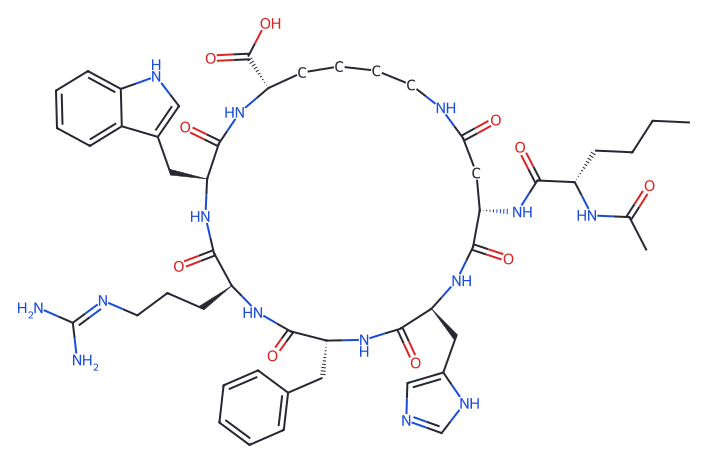
Melanotan II, terminating in an acid rather than an amide.
PubChem CID 9941379
- Also known as: bremelanotide
- Sequence: Ac-Nle-cyclo[Asp-His-D-Phe-Arg-Trp-Lys]-OH
- CAS number: 189691-06-3
- Molecular formula: C50H68N14O10
- Molecular weight: 1025.2 g/mol
- Classification: Melanocortin receptor agonist, MC4R-preferring
One functional group’s difference
Set the two formulae side by side and the relationship to Melanotan II is exact:
- Melanotan II: C50H69N15O9 — 1024.2 g/mol, ending in an amide (–NH2)
- PT-141: C50H68N14O10 — 1025.2 g/mol, ending in a carboxylic acid (–OH)
The difference is one hydrogen and one nitrogen removed, one oxygen added: the C-terminal amide replaced by an acid. Everything else — the macrocycle, the acetylated N-terminus, the D-phenylalanine, the entire receptor-binding core — is identical.
PT-141 is in fact the deamidated metabolite of Melanotan II. It is what the body produces from the parent compound, isolated and developed as a molecule in its own right.
How it was found
The discovery is a genuine example of following an unexpected observation rather than a hypothesis.
Melanotan II was developed to study pigmentation. During its investigation, spontaneous erections were noted as an effect in male subjects — unrelated to the pigmentation the work was about, and consistent enough to be worth pursuing rather than dismissing.
Pursuing it meant asking whether the two effects could be separated. They arise from different melanocortin receptors: pigmentation from MC1R on melanocytes, sexual response from MC4R in the central nervous system. A compound biased toward MC4R and away from MC1R should therefore produce one without the other.
The deamidated metabolite turned out to be exactly that. PT-141 retains central activity with substantially reduced activity at the pigmentation receptor — the separation that Melanotan II’s non-selectivity makes impossible.
Mechanism of action
PT-141 acts principally at MC4R, expressed in hypothalamic regions involved in sexual response. Its mechanism is central — it operates on neural pathways rather than on peripheral tissue.
That distinction is the substantive point about this compound. The familiar pharmacological approach to erectile function works peripherally: phosphodiesterase inhibitors act on vascular smooth muscle to permit blood flow, and require existing arousal signalling to have something to act upon. PT-141 works at the level of the signalling itself, upstream in the central nervous system.
Two different targets, two different points in the same pathway. For research purposes they are not interchangeable, and studies examining one are not evidence about the other.
The melanocortin family in this catalogue
Three compounds here derive from alpha-MSH, and together they map its activities onto its receptors:
- Melanotan I — MC1R-preferring; pigmentation.
- Melanotan II — non-selective across MC1R, MC3R, MC4R and MC5R.
- PT-141 — MC4R-preferring; central effects with reduced pigmentation activity.
A fourth, KPV, comes from the opposite end of the same hormone and carries anti-inflammatory activity with no receptor-mediated pigmentation effect at all. Read as a set, the four demonstrate the principle better than any of them does alone.
Regulatory status
Bremelanotide is an approved prescription medicine in the United States, marketed for hypoactive sexual desire disorder in premenopausal women.
The same two consequences apply as for the other approved compounds in this catalogue. Material supplied for laboratory research is not a pharmaceutical product — it has not been manufactured, tested or released under the controls governing an approved medicine. And the clinical properties documented in the trial literature were established with the approved product, not with research material.
Reported observations
Trial reports describe nausea as the most common finding, along with flushing and headache. Transient increases in blood pressure and decreases in heart rate have been reported, which is why the trial literature examines cardiovascular parameters specifically rather than treating the compound as free of systemic effects.
Because MC1R activity is reduced rather than eliminated, darkening of pigmented areas has also been reported with repeated exposure — a smaller version of the effect that defines Melanotan II.
Handling, reconstitution and storage
- Lyophilised storage: sealed, refrigerated, protected from light. Freeze for long-term storage.
- Robust for a peptide. Cyclisation and N-terminal acetylation make this a rigid, protease-resistant molecule, as with Melanotan II.
- The single tryptophan is photosensitive, so keeping vials dark remains worthwhile.
- Reconstitution: add diluent slowly down the vial wall, allow to dissolve undisturbed, do not shake.
- Concentration: our peptide reconstitution calculator converts vial quantity, diluent volume and syringe size into concentration per unit.
Purity and analytical verification
This compound presents the hardest identity problem in the catalogue, and it follows directly from the relationship described above.
PT-141 and Melanotan II differ by one mass unit — 1025.2 against 1024.2. They share a macrocycle, a synthesis route and closely similar chromatographic behaviour. One is the metabolite of the other, so they are not merely similar molecules but chemically adjacent ones.
Resolving 1 Da out of 1,025 requires genuine mass accuracy. A low-resolution instrument reporting “approximately 1025” has not distinguished these two compounds, and a batch containing appreciable Melanotan II would be a materially different product — non-selective where PT-141 is MC4R-preferring, and carrying the pigmentation activity this compound exists to avoid.
The cyclisation check that applies to Melanotan II applies here too: forming the macrocycle releases water, so uncyclised material is 18 Da heavier and easily spotted. That one is straightforward. The 1 Da question is not, and it is the one worth asking a supplier about specifically — what instrument, what resolution, and can they demonstrate separation from the parent compound.
We publish third-party certificates of analysis by batch.
References
- Molinoff PB, Shadiack AM, Earle D, et al. PT-141: a melanocortin agonist for the treatment of sexual dysfunction. Annals of the New York Academy of Sciences, 2003. PMID 12851303
- Diamond LE, Earle DC, Rosen RC, et al. Double-blind, placebo-controlled evaluation of the safety, pharmacokinetic properties and pharmacodynamic effects of intranasal PT-141. International Journal of Impotence Research, 2004. PMID 14963471
- Kingsberg SA, Clayton AH, Portman D, et al. Bremelanotide for the treatment of hypoactive sexual desire disorder: two randomized phase 3 trials. Obstetrics & Gynecology, 2019. PMID 31599840
Summary
PT-141 (bremelanotide) is a cyclic heptapeptide melanocortin agonist, Ac-Nle-cyclo[Asp-His-D-Phe-Arg-Trp-Lys]-OH, CAS 189691-06-3, molecular formula C50H68N14O10, molecular weight 1025.2 g/mol. It is the deamidated metabolite of Melanotan II, differing by a single functional group and one mass unit, and it exists because an unexpected observation during pigmentation research turned out to be separable from the pigmentation. It acts centrally at MC4R rather than peripherally on vasculature, which distinguishes it mechanistically from the familiar phosphodiesterase inhibitors. It is an approved prescription medicine, and its 1 Da separation from its parent compound makes mass resolution a genuine analytical requirement rather than a formality.
For laboratory research use only. Not for human consumption. This material is not a drug, food, or cosmetic and may not be sold or used for any purpose other than in vitro or non-human laboratory research. References to clinical studies describe the published scientific literature and are not guidance for use.