
Overview
Semax is a synthetic heptapeptide derived from adrenocorticotropic hormone, studied for neurotrophic and neuroprotective effects. It was developed in Russia in the 1980s and is registered there as a medicine, which places it in an unusual position: better established than most compounds in this catalogue, and simultaneously harder for an outside reader to evaluate.
Chemical identity
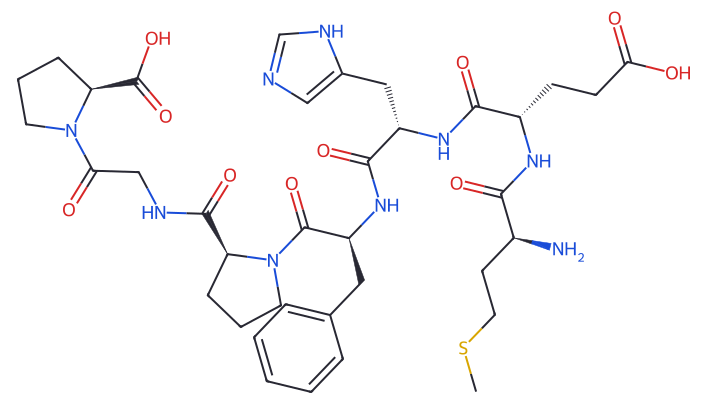
PubChem CID 9811102
- Sequence: Met-Glu-His-Phe-Pro-Gly-Pro
- CAS number: 80714-61-0
- Molecular formula: C37H51N9O10S
- Molecular weight: 813.92 g/mol
- Classification: ACTH(4-7) analogue, heptapeptide
- Appearance: White lyophilised powder
The single sulfur atom in the formula is the N-terminal methionine, which is the compound’s main chemical vulnerability.
A hormone fragment without the hormone’s job
ACTH is a 39-residue pituitary hormone whose defining function is instructing the adrenal cortex to produce cortisol. It also has effects on the central nervous system, on learning and attention, that have been recognised since the 1960s and are entirely separate from the adrenal signalling.
Those two activities live in different parts of the molecule. The corticotropic function requires a longer stretch of the sequence; the behavioural effects were localised to a short fragment near the N-terminus, ACTH(4-10).
Semax takes the first four residues of that fragment — Met-Glu-His-Phe — and replaces the rest:
- ACTH(4-10): Met-Glu-His-Phe-Arg-Trp-Gly
- Semax: Met-Glu-His-Phe-Pro-Gly-Pro
The result retains the neurotropic activity of the fragment and does not stimulate cortisol release. This is the third instance of the same principle in this catalogue: the hGH fragment isolates growth hormone’s effect on fat from its effect on growth, and KPV isolates alpha-MSH’s anti-inflammatory activity from its pigmentation activity. Hormones are modular, and fragments can inherit one activity without the others.
The Pro-Gly-Pro tail
The three residues replacing the end of the ACTH fragment are not filler. Pro-Gly-Pro is a glyproline motif, and it is there for stability.
Proline is conformationally awkward — its side chain loops back onto the backbone nitrogen, creating a rigid kink that many peptidases cannot process. A proline-flanked C-terminus is therefore substantially harder to degrade from that end than an ordinary one. The native ACTH fragment is cleared within minutes; the modified peptide lasts considerably longer.
The same motif appears in Selank, another Russian-developed short peptide, which pairs Pro-Gly-Pro with a different active fragment. Selank and Semax are best understood as products of the same design approach rather than as chemically similar molecules — a stabilising tail bolted onto whichever fragment carries the activity of interest.
Mechanism of action
The most developed account concerns neurotrophins — the growth factors that maintain neuronal survival and plasticity. Published work reports that Semax increases levels of brain-derived neurotrophic factor (BDNF) and nerve growth factor (NGF) in brain tissue, along with their receptors.
That is an indirect mechanism, and worth being clear about: the compound is not itself a neurotrophin and does not bind neurotrophin receptors. It appears to influence the expression of factors that do. How a seven-residue peptide produces that change is not fully established, and the gap between “increases BDNF” and a defined molecular pathway is where most of the remaining uncertainty sits.
Areas of research investigation
Neuroprotection after ischaemia
The application for which the compound is registered in Russia, with studies in stroke models and clinical settings there.
Cognition and attention
Work following the original ACTH fragment observations, examining learning, memory and attention endpoints.
Neurotrophin biology
Separately from any application, the compound is used as a tool for studying BDNF and NGF regulation.
The shape of the evidence
Semax presents an assessment problem that is worth stating openly.
On one hand it is more established than most compounds here: it has been through a formal registration process in a national regulator, has decades of use behind it, and is not a purely preclinical compound.
On the other, that process took place in a single country whose regulatory standards and publication practices differ from those the rest of this catalogue’s literature is judged by. A large proportion of the research is Russian-language, much of it is not indexed in the databases most researchers use, and full texts are frequently unavailable. Independent replication outside Russia is limited.
The honest position is that Semax is neither well-validated by international standards nor fairly described as unsupported. It is a compound with a substantial evidence base that is difficult to audit — a different situation from a thin evidence base, and one that calls for reading the accessible primary literature rather than relying on summaries.
Handling, reconstitution and storage
- Methionine oxidation is the principal degradation route, and the methionine here is the N-terminal residue, exposed rather than buried. Minimise headspace air in opened vials and avoid oxidising conditions in diluents.
- Lyophilised storage: sealed, refrigerated, protected from light. Freeze for long-term storage.
- Little photosensitivity. No tryptophan and no tyrosine; phenylalanine is comparatively stable to light.
- Reconstitution: add diluent slowly down the vial wall, allow to dissolve undisturbed, do not shake.
- Concentration: our peptide reconstitution calculator converts vial quantity, diluent volume and syringe size into concentration per unit.
Purity and analytical verification
A seven-residue synthesis of standard amino acids is straightforward, so deletion sequences are a modest concern and purity figures should be high.
The check specific to this compound is methionine oxidation. Each oxidation event adds sixteen mass units, and on an 814 g/mol peptide that is a clearly resolvable shift — oxidised material appears as a distinct species rather than hiding beneath the main peak. A mass figure therefore reports on storage history as well as identity, which is useful for a compound whose only real vulnerability is that residue.
One further point applies to short peptides with basic residues. Histidine will carry counterions from purification, so as with KPV, gross vial mass and net peptide content are not the same number, though the discrepancy is proportionally smaller here than for a tripeptide.
We publish third-party certificates of analysis by batch.
References
Confidence in these citations is lower than for most pages in this library — see the note on evidence above.
- Dolotov OV, Karpenko EA, Inozemtseva LS, et al. Semax, an analogue of adrenocorticotropin (4-10), binds specifically and increases levels of brain-derived neurotrophic factor protein in rat basal forebrain. Journal of Neurochemistry, 2006. PMID 16635254
- Ashmarin IP, Nezavibatko VN, Levitskaya NG, et al. Design and investigation of an ACTH(4-10) analogue lacking D-amino acids and hydrophobic radicals. Neuroscience Research Communications, 1995. (not indexed in PubMed)
Summary
Semax is a synthetic heptapeptide, Met-Glu-His-Phe-Pro-Gly-Pro, CAS 80714-61-0, molecular formula C37H51N9O10S, molecular weight 813.92 g/mol. It takes the first four residues of the neuroactive ACTH(4-10) fragment and appends a Pro-Gly-Pro tail for protease resistance, retaining the fragment’s central effects without stimulating cortisol release. Its reported mechanism runs through increased expression of BDNF and NGF rather than through direct receptor binding. It is registered as a medicine in Russia, and its evidence base is substantial but difficult to audit from outside that literature.
For laboratory research use only. Not for human consumption. This material is not a drug, food, or cosmetic and may not be sold or used for any purpose other than in vitro or non-human laboratory research.