
Overview
Selank is a synthetic heptapeptide developed at the Institute of Molecular Genetics of the Russian Academy of Sciences, studied for anxiolytic and stress-related effects. Like Semax, it is registered as a medicine in Russia.
It is not part of our catalogue. It is documented because the two compounds are products of the same programme and the same design idea, and understanding either is easier with the other in view.
Chemical identity
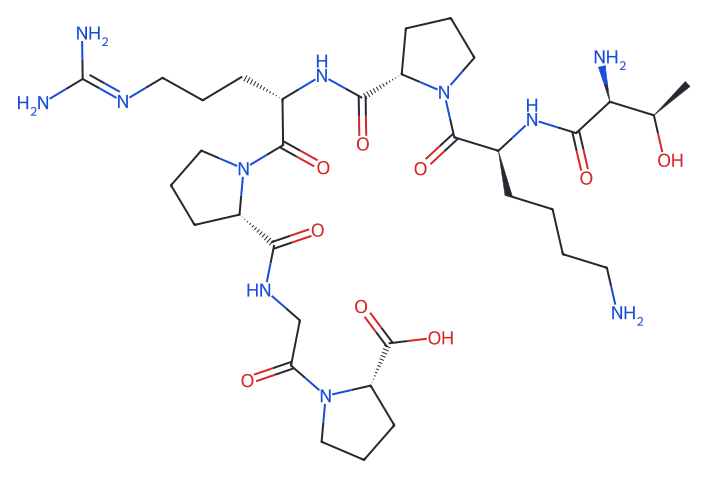
Thr-Lys-Pro-Arg-Pro-Gly-Pro.
PubChem CID 11765600
- Sequence: Thr-Lys-Pro-Arg-Pro-Gly-Pro
- CAS number: 129954-34-3
- Molecular formula: C33H57N11O9
- Molecular weight: 751.9 g/mol
- Classification: Tuftsin analogue, heptapeptide
Note the composition: no sulfur, so no methionine or cysteine, and no aromatic residues. Three of the seven residues are proline.
Tuftsin, plus a tail
Selank is built the same way Semax is, and seeing the pattern makes both compounds legible.
The active portion is tuftsin — Thr-Lys-Pro-Arg — a natural tetrapeptide released by proteolysis from the Fc region of immunoglobulin G. It was identified in the 1970s and named after Tufts University, where the work was done. Tuftsin has documented immunomodulatory activity, and effects on behaviour were reported subsequently.
Its limitation is the familiar one: as a four-residue peptide with free termini, it is degraded almost immediately.
The solution applied was the same one used for Semax. A Pro-Gly-Pro tail is appended, and proline’s rigid backbone kink makes the C-terminus resistant to the peptidases that would otherwise dismantle it.
- Semax = ACTH(4-7) + Pro-Gly-Pro
- Selank = tuftsin + Pro-Gly-Pro
Two compounds, one method: identify a short natural fragment carrying an activity of interest, then bolt on a standard stabilising motif. It is a genuine design philosophy rather than a coincidence, and it characterises the output of that research programme.
Mechanism of action
The reported mechanism concerns GABAergic signalling — the principal inhibitory neurotransmitter system, and the one most anxiolytic compounds act on in some fashion.
Published work describes Selank as influencing expression of genes involved in GABA transmission rather than binding GABA receptors directly. That is an important distinction: benzodiazepines bind a defined site on the GABA-A receptor, whereas the account offered here is transcriptional and indirect.
Reported effects on brain-derived neurotrophic factor also appear in the literature, overlapping with what is described for Semax — which is either evidence of a shared mechanism between two related peptides, or evidence that the same research group applies the same assays. Both readings are available and the literature does not clearly separate them.
Areas of research investigation
Anxiety and stress
The primary application, and the basis for its registration in Russia. Studies cover animal anxiety models and clinical work conducted there.
Immune modulation
Following from tuftsin’s own documented activity, some work examines immune parameters — the one area where the parent peptide’s known biology gives a clear prior expectation.
Neurotrophic signalling
Studies examining BDNF and related factors, overlapping with the Semax literature.
The evidence, and its limits
The position is essentially the same as for Semax, and the same caution applies.
Selank has been through a national registration process and has decades of use behind it in one country. But the great majority of its literature is Russian-language, much is not indexed in the databases most researchers search, and independent replication elsewhere is limited. A compound can be simultaneously well used and poorly evidenced by international standards, and this is such a case.
The practical advice is the same too: read the accessible primary literature directly rather than relying on secondary summaries, which tend to report the strongest claims without the qualifications attached to them.
Handling and storage
- Unusually robust. No methionine or cysteine means no oxidation-prone residues; no tryptophan means little photosensitivity. The three prolines make the backbone rigid.
- Highly water-soluble, thanks to lysine and arginine.
- Lyophilised storage: sealed, refrigerated; freeze for long-term storage.
- Reconstitution: add diluent slowly down the vial wall and allow to dissolve undisturbed.
Purity and analytical verification
A seven-residue synthesis of standard amino acids is straightforward, and purity should be high without difficulty. There is no unusual residue to substitute, no stereochemistry to invert beyond the standard L-forms, and no modification to omit — so a routine certificate genuinely answers the question, as it does for MOTS-c and for the same reason.
The one point worth noting is the counterion. Selank carries both lysine and arginine, two basic residues, so it will be isolated as a salt with trifluoroacetate or similar. As with KPV, gross vial mass and net peptide content differ, and the salt form should be stated.
References
Confidence in these citations is lower than for most pages in this library, for the reasons set out above.
- Volkova A, Shadrina M, Kolomin T, et al. Selank administration affects the expression of some genes involved in GABAergic neurotransmission. Frontiers in Pharmacology, 2016. PMID 26924987
- Zozulya AA, Neznamov GG, Siuniakov TS, et al. Efficacy and possible mechanisms of action of a new peptide anxiolytic Selank in the therapy of generalized anxiety disorders and neurasthenia. Zhurnal Nevrologii i Psikhiatrii, 2008. PMID 18454096
Summary
Selank is a synthetic heptapeptide, Thr-Lys-Pro-Arg-Pro-Gly-Pro, CAS 129954-34-3, molecular formula C33H57N11O9, molecular weight 751.9 g/mol. It joins tuftsin — a natural immunomodulatory tetrapeptide released from immunoglobulin G — to a Pro-Gly-Pro stabilising tail, exactly as Semax joins that same tail to a fragment of ACTH. Reported activity concerns GABAergic signalling, described transcriptionally rather than through direct receptor binding. It is registered as a medicine in Russia, and its evidence base carries the same accessibility limitations as Semax’s. We do not stock it.
This page is provided for research reference. Compounds described in this library are for laboratory research use only, are not drugs, foods or cosmetics, and may not be used for any purpose other than in vitro or non-human laboratory research.