
Overview
DSIP — delta sleep-inducing peptide — is a nonapeptide isolated in the late 1970s and studied in relation to sleep, stress response and thermoregulation.
It is unusual among the compounds in this catalogue in that its name states a claim which the subsequent literature has not settled. That is the most useful thing to know about it, so it is addressed directly below rather than after several paragraphs of description.
Chemical identity
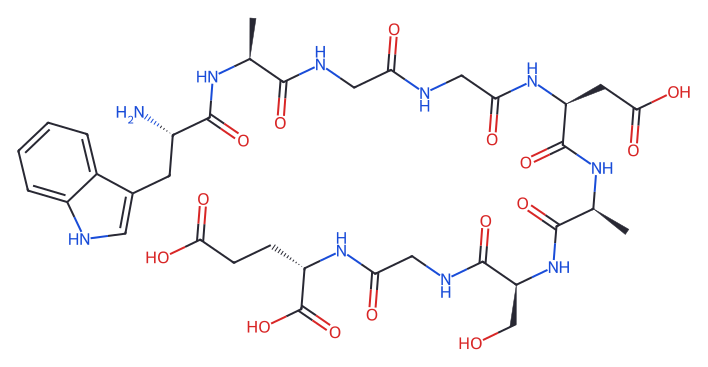
Trp-Ala-Gly-Gly-Asp-Ala-Ser-Gly-Glu.
PubChem CID 68816
- Sequence: Trp-Ala-Gly-Gly-Asp-Ala-Ser-Gly-Glu
- CAS number: 62568-57-4
- Molecular formula: C35H48N10O15
- Molecular weight: 848.8 g/mol
- Classification: Neuropeptide, nonapeptide
- Appearance: White lyophilised powder
The composition is worth noting for reasons that matter later: the sequence contains no basic residues at all — no lysine, arginine or histidine — and two acidic ones. It is a strongly anionic peptide. The single tryptophan is the only residue with meaningful photosensitivity, and there is no sulfur, so no oxidation-prone methionine or cysteine.
How it was found
The discovery is a period piece, and worth recounting because it explains both the name and the difficulty.
In the 1970s, Schoenenberger and Monnier at Basel were investigating whether sleep is mediated by a circulating factor. Their approach was direct: induce sleep in rabbits by electrically stimulating the thalamus, collect blood from the cerebral venous system during that state, and look for something present that had not been there before.
They isolated a peptide fraction, and reported that transferring it to other animals induced the delta-wave EEG pattern characteristic of deep sleep. The peptide was named for that observation — delta sleep-inducing peptide — and characterised as the nonapeptide above.
The name is a hypothesis, not a description
What followed is the reason this compound needs careful handling.
Subsequent attempts to reproduce the sleep-inducing effect gave inconsistent results. Some studies reported effects on sleep architecture; others found none. The findings varied with species, dose, route and timing, in a pattern more characteristic of an unreliable effect than of a real one being measured imprecisely.
Nearly five decades later there is still no identified receptor for DSIP, no established mechanism, and no consensus that it functions as a sleep-regulating molecule in normal physiology. A 2006 review in a mainstream neurochemistry journal characterised it as an unresolved riddle, which remains a fair summary.
The name has nonetheless persisted, and it does a great deal of work in secondary descriptions — a compound called “delta sleep-inducing peptide” is read as one that induces delta sleep. It is more accurate to say that the name records what its discoverers were looking for when they found it.
What has been examined
Setting the sleep question aside, the literature covers several areas, generally in small studies:
Stress response
Some of the more durable findings concern stress physiology, including reported effects on stress-induced changes in animal models. This line is arguably better supported than the sleep work.
Thermoregulation and analgesia
Reported effects on body temperature regulation and on pain responses in animal models.
Endocrine interactions
Studies examining interactions with pituitary hormone release, including reports relating to corticotropin and somatotropin.
None of these constitutes a well-established function, and all should be read as reports rather than as settled results.
Mechanism
Unknown, and it is better to say so than to offer speculation dressed as explanation.
No specific receptor has been identified. Proposals in the literature have included interactions with various neurotransmitter systems and effects on neuronal excitability, but none has been established in the way that, for example, ghrelin receptor agonism has been established for the growth hormone secretagogues in this catalogue.
For a research setting the implication is that DSIP is a compound to investigate rather than a tool to investigate other things with. Compounds with defined targets can be used to probe those targets; a compound without one cannot.
Handling, reconstitution and storage
- Highly water-soluble. The acidic residues and absence of hydrophobic bulk make this an easy peptide to dissolve.
- Protect from light. The single tryptophan is the main degradation route; there is no methionine or cysteine, so oxidation is otherwise not a concern.
- Lyophilised storage: sealed, refrigerated, protected from light. Freeze for long-term storage.
- Reconstitution: add diluent slowly down the vial wall, allow to dissolve undisturbed, do not shake.
- Concentration: our peptide reconstitution calculator converts vial quantity, diluent volume and syringe size into concentration per unit.
Purity and analytical verification
A nine-residue synthesis of standard amino acids is straightforward, and purity figures should be high without difficulty. Two points are specific to this peptide.
Tryptophan oxidation adds sixteen mass units per event, clearly resolvable on an 849 g/mol peptide. As with GHRP-6, that makes a mass figure informative about storage as well as identity.
The counterion question runs opposite to most peptides here. Peptides purified by reversed-phase HPLC are isolated as salts, and for basic peptides such as KPV that means trifluoroacetate associating with lysine or arginine. DSIP has no basic residues at all, so it does not carry TFA in the same way — it is more likely to be supplied as a sodium or ammonium salt of the acidic groups, or as the free acid.
The practical consequence is the same even though the chemistry is reversed: gross vial mass and net peptide content are not identical, and the salt form should be stated. It is simply a different salt than most people assume.
We publish third-party certificates of analysis by batch.
References
- Schoenenberger GA, Monnier M. Characterization of a delta-electroencephalogram (sleep)-inducing peptide. Proceedings of the National Academy of Sciences, 1977. PMID 265572
- Graf MV, Kastin AJ. Delta-sleep-inducing peptide (DSIP): a review. Neuroscience & Biobehavioral Reviews, 1984. PMID 6145137
- Kovalzon VM, Strekalova TV. Delta sleep-inducing peptide (DSIP): a still unresolved riddle. Journal of Neurochemistry, 2006. PMID 16539679
Summary
DSIP is a nonapeptide, Trp-Ala-Gly-Gly-Asp-Ala-Ser-Gly-Glu, CAS 62568-57-4, molecular formula C35H48N10O15, molecular weight 848.8 g/mol, isolated in 1977 from the cerebral venous blood of rabbits in electrically induced sleep. Its name records the circumstances of its discovery rather than an established function: sleep effects have not replicated consistently, no receptor has been identified, and the mechanism remains unknown nearly fifty years on. Work on stress response is arguably better supported than the sleep literature. It is best understood as an open question in neuropeptide research rather than a characterised tool.
For laboratory research use only. Not for human consumption. This material is not a drug, food, or cosmetic and may not be sold or used for any purpose other than in vitro or non-human laboratory research.